Green Synthesis of Magnesium Oxide Nanoparticles Using Alcoholic Extract of Camellia sinensis and their Antibacterial and Anti-Biofilm Activity against Multidrug-Resistant Pathogenic Bacteria
DOI:
https://doi.org/10.32007/jfacmedbaghdad3261Keywords:
Antibacterial activity, Biofilm inhibition, Camellia sinensis, Green synthesis, Magnesium Oxide nanoparticles (MgO NPs)Abstract
Background: Multidrug resistance bacteria is rapidly spreading globally and has created an urgent need for alternative antimicrobial strategies to combat these bacteria. Green nanotechnology is an eco-friendly way of synthesizing Bioactive Nanoparticles with enhanced antimicrobial activities compared to conventional methods.
Objectives: The purpose of this study was to "green" synthesize magnesium oxide nanoparticles (MgO NPs) from an alcohol extract of Camellia sinensis (tea plant) and evaluate their antibacterial and anti-biofilm activity against clinical multidrug resistance bacterial isolates.
Methods: Magnesium Oxide nanoparticles were synthesized utilizing an alcohol extract of Camellia sinensis as a reducing/stabilizing agent. The synthesized MgO NPs were characterized by UV–Vis Spectroscopy, FTIR, XRD, SEM, AFM, EDX, AAS, and Zeta Potential analyses. The antibacterial activity of the MgO NPs was determined using minimum inhibitory concentration (MIC) determinations while their anti-biofilm activity was assessed by a microtiter plate crystal violet assay against clinical MDR Enterococcus faecalis and Klebsiella pneumoniae isolates. Data were expressed as mean ± SD.
Results: According to the study, MgO nanoparticles that were created by biosynthetic means had an average particle size range of 52-104 nm (SEM) and had evidence of nanoscale surface roughness from AFM. They also showed high colloidal stability with zeta potentials of -44.61 mV. MgO nanoparticles exhibited very strong (dose-dependent antibacterial effect on both E. faecalis and K. pneumoniae with a MIC value of 12.5 µg/ml, and significantly reduced biofilm formation by 95.45-100% at sub-MIC concentrations.
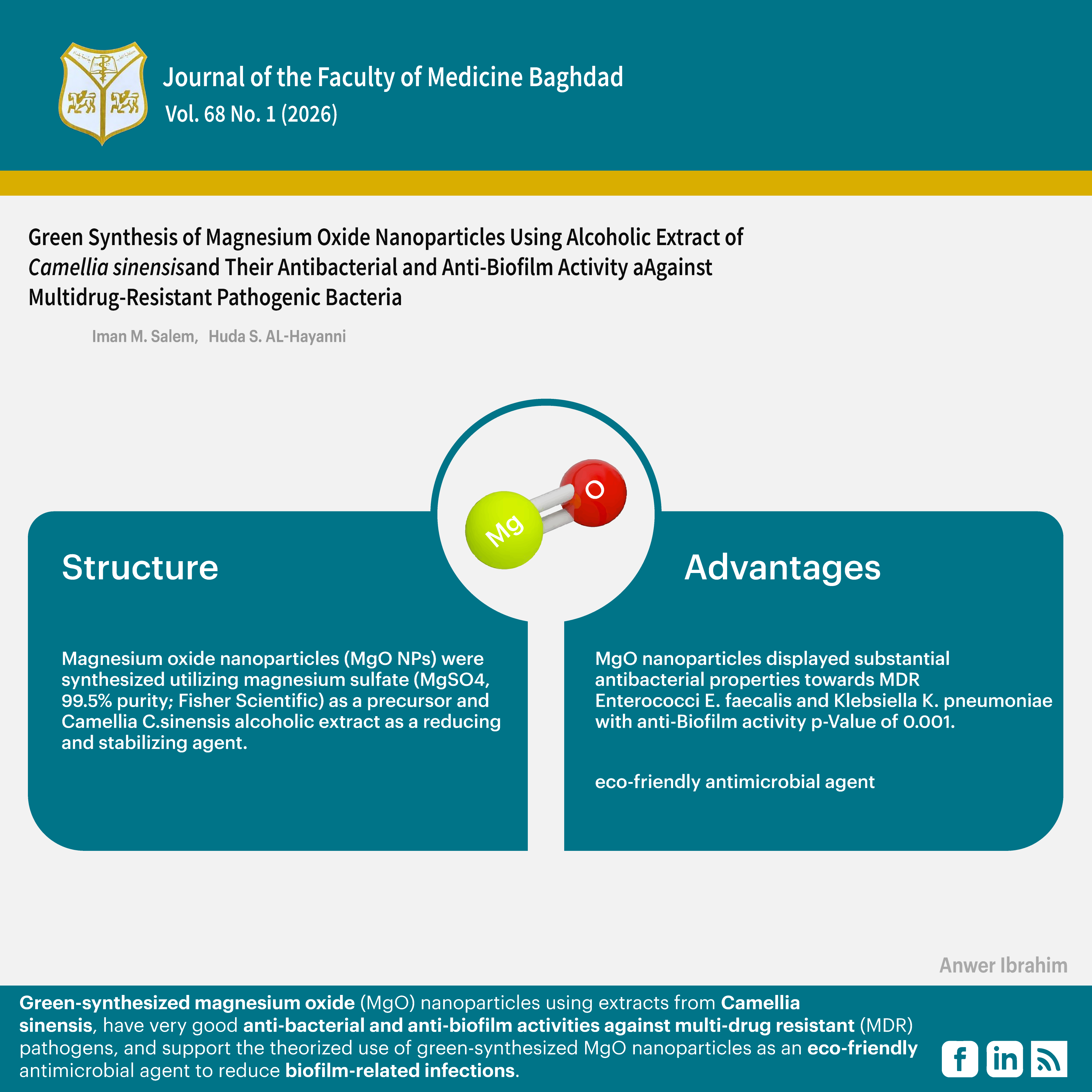
Conclusion: Green-synthesized magnesium oxide (MgO) nanoparticles using extracts from Camellia sinensis, have very good anti-bacterial and anti-biofilm activities against multi-drug resistant (MDR) pathogens, and support the theorized use of green-synthesized MgO nanoparticles as an eco-friendly antimicrobial agent to reduce biofilm-related infections.
Received: Jan. 2026
Revised: Feb. 2026
Accepted: March 2026
Published online: March 2026
Published: April 2026
Published: April 2026
References
1. González-Vázquez R, Córdova-Espinoza MG, Escamilla-Gutiérrez A, et al. Detection of mecA genes in hospital-acquired MRSA and SOSA strains associated with biofilm formation. Pathogens. 2024;13(3):212. https://doi:10.3390/pathogens13030212.
2. Vadaga BS, Sharma S, Batchu R, et al. Unveiling the role of outer membrane proteins (OMPs) in biofilm formation and Harnessing them for targeting biofilm-forming bacterial infections. World J Microbiol Biotechnol. 2026; 42(2): 49. https://doi.org/10.1007/s11274-025-04732-w.
3. Sharma S, Mohler J, Mahajan SD, et al. Microbial biofilm: a review on formation, infection, antibiotic resistance, control measures, and innovative treatment. Microorganisms. 2023; 11(6): 1614. https://doi.org/10.3390/microorganisms11061614.
4. Al-Shimmary SM, Shehab ZH, Jassim EH. Synthesis and characterization of cerium oxide-bacteriocin nanohybrid with synergistic biological activities. Egypt J Basic Appl Sci. 2024;12(1):1–16. https://doi.org/10.1080/2314808X.2024.2442250.
5. Abd Alaameri SK, Al-Hayanni HSA, Al-Zubaidi LAK. Antibacterial and anti-biofilm properties of biosynthesized silver nanoparticles using Rhus coriaria extracts against some pathogenic bacteria. Revis Bionatura. 2023;8(3):53. https://doi.org/10.21931/RB/CSS/2023.08.03.53.
6. Alnuaimi MTA, Al-Hayanni HSA, Aljanabi ZZ. Green synthesis of gold nanoparticles from Sophora flavescens extract and their antibacterial effect against some pathogenic bacteria. Malays J Microbiol. 2023;19(1):74–82. https://doi.org/10.21161/mjm.220060.
7. Salih HH. Biosynthesis of silver nanoparticles by using green tea (Camellia sinensis) extracts. Baghdad Sci J. 2024;21(5):1470-1482. https://doi.org/10.21123/bsj.2023.8344.
8. Taha ZR, Altaai AF, Mohammad TH, et al. Efficacy of silver nanoparticles from Fusarium solani and mycorrhizal inoculation for biological control of Fusarium wilt in tomatoes. Plant Prot. 2024;8(4):635–664. https://doi.org/10.33804/pp.008.04.5343.
9. Ahmad S, Munir S, Zeb N, et al. Green nanotechnology: a review on green synthesis of silver nanoparticles an eco-friendly approach. Int J Nanomedicine. 2019; 14:5087–5107. https://doi.org/10.2147/IJN.S200254.
10. Chegini Z, Shariati A, Alikhani MY, et al. Antibacterial and antibiofilm activity of silver nanoparticles stabilized with C phycocyanin against drug resistant Pseudomonas aeruginosa and Staphylococcus aureus. Front Bioeng Biotechnol. 2024 Oct 23;12:1455385. https://doi.org/10.3389/fbioe.2024.1455385.
11. Alenazy R. Antimicrobial activities and biofilm inhibition properties of Trigonella foenum‑graecum methanol extracts against multidrug‑resistant Staphylococcus aureus and Escherichia coli. Life (Basel). 2023;13(3):703. https://doi.org/10.3390/life13030703.
12. Osman AI, Zhang Y, Farghali M, et al. Synthesis of green nanoparticles for energy, biomedical, environmental, agricultural and food applications: a review. Environ Chem Lett. 2024; 22:841–887. https://doi.org/10.1007/s10311-023-01682-3.
13. Ugo NJ, Ade AR, Joy AT. Nutrient composition of Carica papaya leaves extracts. J Food Sci Nutr Res. 2019;2(3):274–282. https://doi.org/10.26502/jfsnr.2642-11000026.
14. Abass AA, Hassan BA. Antibacterial activity of magnesium oxide nanoparticles biosynthesized from Bacillus subtilis against multidrug-resistant Staphylococcus aureus isolated from different clinical infections in hospitals of Al Najaf province / Iraq. Egypt J Med Microbiol. 2025;34(4):601–608. https://doi.org/10.21608/ejmm.2025.432149.1926.
15. Amina M, Al Musayeib NM, Alarfaj NA, et al. Biogenic green synthesis of MgO nanoparticles using Saussurea costus biomasses for a comprehensive detection of their antimicrobial, cytotoxicity against MCF‑7 breast cancer cells and photocatalysis potentials. PLoS One. 2020;15(8):e0237567. https://doi.org/10.1371/journal.pone.0237567.
16. Hemmami H, Ben Amor I, Zeghoud S, et al. A systematic review of synthesis of MgO nanoparticles and their applications. J Turk Chem Soc A. 2024;11(2):731–750. https://doi.org/10.18596/jotcsa.1247385.
17. Kadhim EM, Amin BK. The antibacterial effect of green tea on Enterococcus faecalis. Med J Babylon. 2022;19(4):676–679. https://doi.org/10.4103/MJBL.MJBL_208_22.
18. Yang Y, Zhang T. Antimicrobial activities of tea polyphenols on phytopathogens: a review. Molecules. 2019;24(4):816. https://doi.org/10.3390/molecules24040816.
19. El-Telbany M, El-Sharaki A. Antibacterial and anti-biofilm activity of silver nanoparticles on multi-drug resistance Pseudomonas aeruginosa isolated from dental-implant. J Oral Biol Craniofac Res. 2022; 12(1): 199-203. https://doi.org/10.1016/j.jobcr.2021.12.002.
20. Elsaid EM, Ahmed OI, Abdo AM, et al. Antimicrobial and antibiofilm effect of silver nanoparticles on clinical isolates of multidrug resistant Klebsiella Pneumoniae. Microb Infect Dis. 2023; 4(2): 542-554. https://doi.org/10.21608/mid.2023.200483.1487.
21. Ramezani FM, Farsadrooh M, Zare I, et al. Green synthesis of magnesium oxide nanoparticles and nanocomposites for photocatalytic antimicrobial, antibiofilm and antifungal applications. Catalysts. 2023; 13(4): 642. https://doi.org/10.3390/catal13040642.
22. Joudeh N, Linke D. Nanoparticle classification, physicochemical properties, characterization, and applications: a comprehensive review for biologists. J Nanobiotechnol. 2022; 20(1): 262. https://doi.org/10.1186/s12951-022-01477-8.
23. Bauer AW, Kirby WMM, Sherris JC, et al. Antibiotic susceptibility testing by a standardized single disk method. Am J Clin Pathol. 1966;45(4):493–496. https://doi.org/10.1093/ajcp/45.4_ts.493.
24. The European Committee on Antimicrobial Susceptibility Testing (EUCAST). Breakpoints and guidance for interpretation of MICs and zone diameters. Version 14.0. Växjö, Sweden: EUCAST; 2024. Available from: https://www.eucast.org/clinical_breakpoints/
25. Khursheed H, Qasim R. Synergistic antibiofilm activity of probiotic Lactobacillus acidophilus and Punica granatum L. against Pseudomonas aeruginosa biofilm. J Ayub Med Coll Abbottabad. 2024;36(2):245–250. https://doi.org/10.55519/JAMC-02-12876
26. Rotti RB, Sunitha DV, Manjuntha R, et al. Green synthesis of MgO nanoparticles and its antibacterial properties. Front Chem. 2023;11:1143614. https://doi.org/10.3389/fchem.2023.1143614.
27. Akshaykranth A, Jayarambabu N, Tumu VR, et al. Comparative study on antibacterial activity of MgO nanoparticles synthesized from Lawsonia inermis leaves extraction and chemical methods. J Inorg Organomet Polym Mater. 2021;31(6):2393–2400. https://doi.org/10.1007/s10904-021-01915-4.
28. Kaman PK, Dutta P. Synthesis, characterisation, and antifungal activity of biosynthesized silver nanoparticles. Indian Phytopathol. 2019; 72:79–88. https://doi.org/10.1007/s42360-018-0081-4.
29. Hamad HK. Evaluation of paromomycin-loaded chitosan nanoparticles and oxidative stress activities against Entamoeba histolytica. J Phys Conf Ser. 2021; 2114:012085. https://doi.org/10.1088/1742-6596/2114/1/012085.
30. Elabbasy MT, El Bayomi RM, Abdelkarim EA, et al. Antibacterial and antibiofilm activity of green-synthesized zinc oxide nanoparticles against multidrug-resistant Escherichia coli. Molecules. 2025;30(4):768. https://doi.org/10.3390/molecules30040768.
31. Silva AA, Sousa AMF, Furtado CRG, et al. Green magnesium oxide prepared by plant extracts: synthesis, properties and applications. Mater Today Sustain. 2022; 18:100203. https://doi.org/10.1016/j.mtsust.2022.100203.
32. Singh J, Dutta T, Kim KH, et al. Green synthesis of metals and metal oxide nanoparticles: applications for environmental remediation. J Nanobiotechnol. 2018;16(1):84. https://doi.org/10.1186/s12951-018-0408-4.
33. Ali R, Shanan ZJ, Saleh GM, et al. Green synthesis and study of some physical properties of MgO nanoparticles and their antibacterial activity. Iraqi J Sci. 2020;61(2):266–276. https://doi.org/10.24996/ijs.2020.61.2.9.
34. Udayagiri H, Sana SS, Dogiparthi LK, et al. Phytochemical fabrication of ZnO nanoparticles and their antibacterial and antibiofilm activity. Sci Rep. 2024; 14:19714. https://doi.org/10.1038/s41598-024-69044-9.
35. Lithi IJ, Ahmed Nakib KI, Chowdhury AMS, et al. A review on the green synthesis of metal (Ag, Cu, and Au) and metal oxide (ZnO, MgO, Co₃O₄, and TiO₂) nanoparticles using plant extracts for developing antimicrobial properties. Nanoscale Adv. 2025;7:2446–2473. https://doi.org/10.1039/D5NA00037H.
36. Younis IY, El-Hawary SS, Eldahshan OA, et al. Green synthesis of magnesium nanoparticles mediated from Rosa floribunda charisma extract and its antioxidant, antiaging and antibiofilm activities. Sci Rep. 2021; 11:16868. https://doi.org/10.1038/s41598-021-96377-6.
37. Sarwar K, Nazli Z, Munir H, et al. Biosynthesis of zinc oxide nanoparticles using Moringa oleifera leaf extract, probing antibacterial and antioxidant activities. Sci Rep. 2025; 15:20413. https://doi.org/10.1038/s41598-025-08839-w.
38. Behzadi E, Sarsharzadeh R, Nouri M, et al. Albumin binding and anticancer effect of magnesium oxide nanoparticles. Int J Nanomedicine. 2019;14:257–270. https://doi.org/10.2147/IJN.S186428.
39. Mohanta YK, Panda SK, Syed A, et al. Bio‑inspired synthesis of silver nanoparticles from leaf extracts of Cleistanthus collinus (Roxb.): its potential antibacterial and anticancer activities. IET Nanobiotechnol. 2018;12(3):343–348. https://doi.org/10.1049/iet-nbt.2017.0203
40. Salem SS. A mini review on green nanotechnology and its development in biological effects. Arch Microbiol. 2023;205:128. https://doi.org/10.1007/s00203-023-03467-2
41. Karthik K, Dhanuskodi S, Gobinath C, et al. Fabrication of MgO nanostructures and their photocatalytic, antibacterial and anticancer performance. J Photochem Photobiol B. 2019; 190:8–20. https://doi.org/10.1016/j.jphotobiol.2018.11.001
42. Nath D, Banerjee P. Green nanotechnology - a new hope for medical biology. Environ Toxicol Pharmacol. 2013;36(3):997-1014. https://doi.org/10.1016/j.etap.2013.09.002.
43. Bruna T, Maldonado-Bravo F, Jara P, Caro N. Silver nanoparticles and their antibacterial applications. Int J Mol Sci. 2021;22(13):7202. https://doi.org/10.3390/ijms22137202.
44. He Y, Ingudam S, Reed S, et al. Study on the mechanism of antibacterial action of magnesium oxide nanoparticles against foodborne pathogens. J Nanobiotechnol. 2016;14(1):54. https://doi.org/10.1186/s12951-016-0202-0.
45. Dehkordi PH, Moshtaghi H, Abbasvali M. Effects of magnesium oxide and copper oxide nanoparticles on biofilm formation of Escherichia coli and Listeria monocytogenes. Nanotechnology. 2023 Feb 3;34(15). https://doi.org/10.1088/1361-6528/acab6f.
46. Huang C, Moradi S, Sholeh M, et al. Global trends in antimicrobial resistance of Enterococcus faecium: a systematic review and meta‑analysis of clinical isolates. Front Pharmacol. 2025;16:1505674. https://doi.org/10.3389/fphar.2025.1505674.
47. Heussien Z, Yousef NA, AbdElfatah KE, et al. Green magnesium oxide nanoparticles (MgO-NPs) as an antibacterial agent against multidrug-resistant bacteria causing tonsillitis. Assiut Univ J Multidiscip Sci Res. 2025;3(1):53–76. https://doi.org/10.21608/aunj.2025.363865.1117.
48. Shkodenko L, Kassirov I, Koshel E. Metal oxide nanoparticles against bacterial biofilms: perspectives and limitations. Microorganisms. 2020;8(10):1545. https://doi.org/10.3390/microorganisms8101545.
49. Azizi‑Lalabadi M, Ehsani A, Divband B, et al. Antimicrobial activity of titanium dioxide and zinc oxide nanoparticles supported in 4A zeolite and evaluation the morphological characteristic. Sci Rep. 2019;9(1):17439. https://doi.org/10.1038/s41598-019-54025-0.
Downloads
Published
Issue
Section
Categories
License
Copyright (c) 2026 Iman M. Salem, Huda S. AL-Hayanni

This work is licensed under a Creative Commons Attribution 4.0 International License.













 Creative Commons Attribution 4.0 International license..