The Clinical and Laboratory Profiles of Neonatal Thrombocytopenia in a Tertiary Neonatal Intensive Care Unit in Baghdad, Iraq
DOI:
https://doi.org/10.32007/jfacmedbaghdad3255الكلمات المفتاحية:
Bleeding، Neonatal Thrombocytopenia، Neonatal Intensive Care Unit، Platelet transfusion، Perinatal Asphyxia، Sepsisالملخص
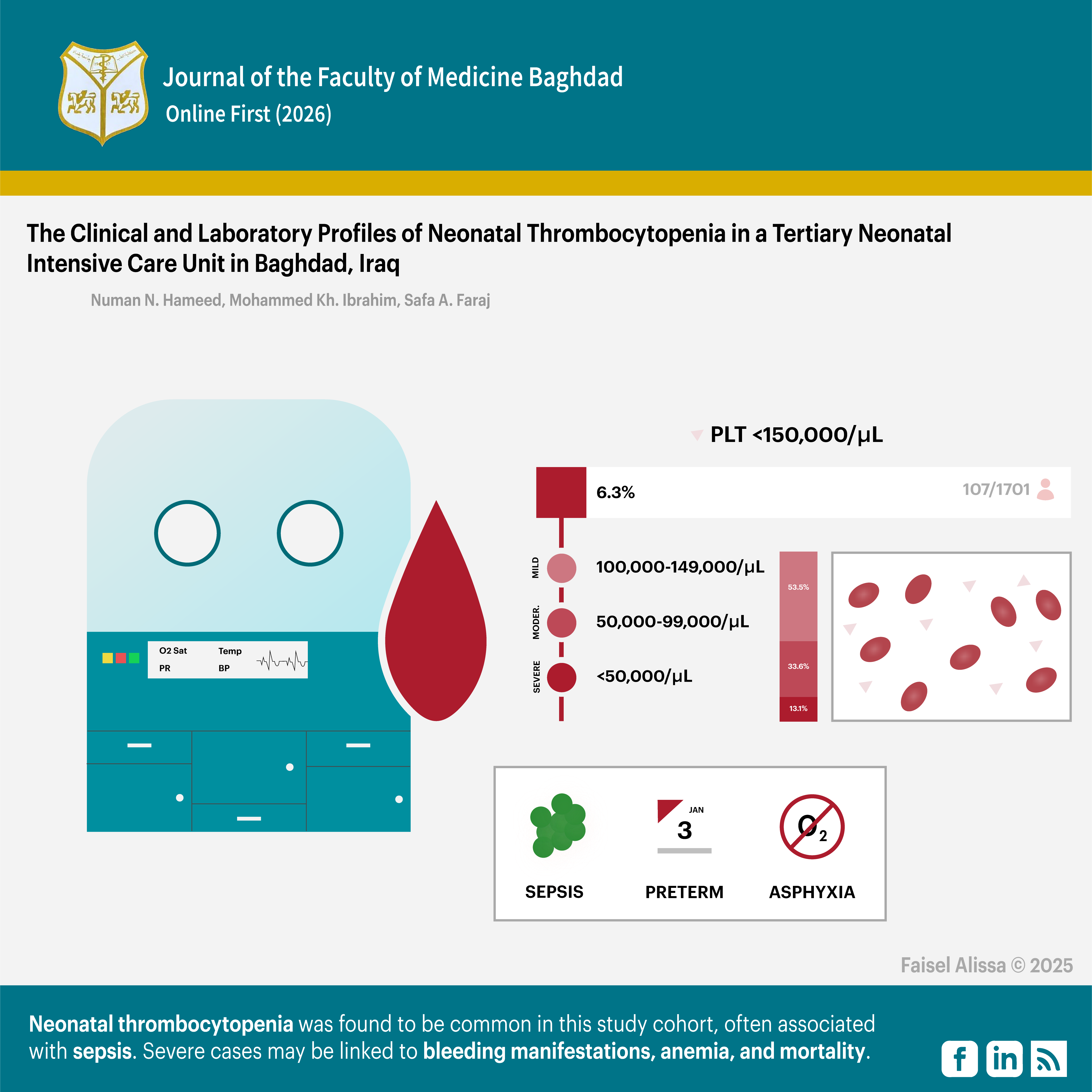
Background: Neonatal Thrombocytopenia (NT) is defined as a platelet count of <150,000/microL and is classified as: Mild (platelet count 100,000- 149,000/microL), moderate (50,000- 99,000/microL), and Severe (<50,000/microL). It is classified according to the time of presentation as: Early NT (occurs within the first 72 hours of life) and Late NT (occurs after 72 hours).
Objectives: To study the clinical and laboratory profiles of neonatal thrombocytopenia in the Neonatal Intensive Care Unit of the Children Welfare Teaching Hospital, Baghdad.
Methods: This single-center case series observational study was conducted from 1st May 2022 to 30th April 2023, in the Neonatal Intensive Care Unit of the Children Welfare Teaching Hospital, Baghdad. Neonates with thrombocytopenia, defined as a platelet count <150,000/µL, were enrolled. Complete blood count, C-reactive protein, blood culture, and other investigations were performed as clinically indicated. Data were analyzed using IBM SPSS version 29. Categorical variables were analyzed using the Pearson chi-square test or Fisher’s exact test, as appropriate, and a P-value of <0.05 was considered statistically significant.
Results: Among the 1701 neonates admitted to the NICU, 107 (6.3%) developed neonatal thrombocytopenia. Mild thrombocytopenia was the most common category, occurring in 57 cases (53.3%), followed by moderate thrombocytopenia in 36 (33.6%) and severe thrombocytopenia in 14 (13.1%). Out of the total cases, there were more preterm 61 (57.0%) than full term neonates 46 (43.0%). Sepsis was the most common associated condition, identified in 53 cases (49.6%), followed by asphyxia in 11 cases (10.3%). Severe thrombocytopenia was significantly associated with hemoglobin <15 g/dL (P=0.04), bleeding from venipuncture and cannula sites (P=0.034), and death (P=0.0001).
Conclusion: Neonatal thrombocytopenia was found to be common in this study cohort, with sepsis being the leading associated condition. Severe cases seem to be linked to bleeding manifestations, anemia, and mortality, which highlight the importance of careful monitoring of affected neonates.
التنزيلات
المراجع
1. Eichenwald EC, Hansen AR, Martin CR, et al. Cloherty and Stark’s Manual of Neonatal Care, 9e. Lippincott Williams & Wilkins, a Wolters Kluwer business; 2023. Accessed April 26, 2026. https://pediatrics.lwwhealthlibrary.com/book.aspx?bookid=3234§ionid=0.
2. Christensen RD, Baer VL, Henry E, et al. Thrombocytopenia in small-for-gestational-age infants. Pediatrics.2015;136(2):e361-e370. https://doi.org/10.1542/peds.2014-4182.
3. Christensen RD, Henry E, Wiedmeier SE, et al. Thrombocytopenia among extremely low birth weight neonates: data from a multihospital healthcare system. J Perinatol. 2006;26(6):348-353. https://doi.org/10.1038/sj.jp.7211509.
4. Baer VL, Lambert DK, Henry E, et al. Severe thrombocytopenia in the NICU. Pediatrics. 2009;124(6):e1095-e1100. https://doi.org/10.1542/peds.2009-0582.
5. Donato H. Neonatal thrombocytopenia: A review. I. Definitions, differential diagnosis, causes, immune thrombocytopenia. Arch Argent Pediatr. 2021;119(3):e202-e214. https://doi.org/10.5546/aap.2021.eng.e202.
6. Morrone K. Thrombocytopenia in the newborn. NeoReviews. 2018 Jan 1;19(1):e34-41.
https://doi.org/10.1542/neo.19-1-e34.
7. Stanworth SJ, Mumford AD. How I diagnose and treat neonatal thrombocytopenia. Blood. 2023 Jun 1;141(22):2685-97. https://doi.org/10.1182/blood.2022018017.
8. Won Lee S, Clinton TA, Kim SK. Fetal/neonatal alloimmune-mediated thrombocytopenia and recurrent pregnancy loss. In: Kwak-Kim J, editor. Immunology of Recurrent Pregnancy Loss and Implantation Failure. Amesterdam: Academic Press; 2022. 165-175.
https://doi.org/10.1016/B978-0-323-90805-4.00014-6.
9. Sola MC, Del Vecchio A, Rimsza LM. Evaluation and treatment of thrombocytopenia in the NICU. Clin Perinatol. 2000;27(3):655-670. https://doi.org/10.1016/S0095-5108(05)70044-0.
10. Ververidis M, Kiely EM, Spitz L, et al. The clinical significance of thrombocytopenia in neonates with necrotizing enterocolitis. J Pediatr Surg. 2001;36(5):799-803. https://doi.org/10.1053/jpsu.2001.22964.
11. Fressinaud E, Mazurier C, Meyer D. Molecular genetics of type 2 von Willebrand disease. Int J Hematol. 2002;75(1):9-18. https://doi.org/10.1007/BF02981973.
12. Ulusoy E, Tufekci O, Duman N, et al. Thrombocytopenia in neonates: causes and outcomes. Ann Hematol. 2013;92(7):961-967. https://doi.org/10.1007/s00277-013-1726-0.
13. Kusumasari N, Rohsiswatmo R, Gatot D, et al. Incidence and risk factors of neonatal thrombocytopenia: a preliminary study. Pediatr Int. 2010;50(1):31-37. https://doi.org/10.14238/pi50.1.2010.31-7.
14. Eltawel M, AlHarbi T, AlJamaan K, et al. Incidence and outcomes of neonatal thrombocytopenia in a tertiary care facility in central Saudi Arabia. Adv Neonatal Care. 2018;18(5):E3-E12. https://doi.org/10.1097/ANC.0000000000000539.
15. Saber AM, Aziz SP, Almasry AZE, et al. Risk factors for severity of thrombocytopenia in full-term infants: a single center study. Ital J Pediatr. 2021;47:7. https://doi.org/10.1186/s13052-021-00965-1.
16. Sheeja J, Abinaya L, Veena B. Study of Neonatal Thrombocytopenia in a Tertiary Care Hospital. Journal of Contemporary Clinical Practice. 2025; 11(4):632–636. https://doi.org/10.61336/jccp/25-04-95
17. Van der Staaij H, Hooiveld NMA, Caram-Deelder C, et al. Most major bleeds in preterm infants occur in the absence of severe thrombocytopenia: an observational cohort study. Arch Dis Child Fetal Neonatal Ed. 2025;110(2):F122-F127. https://doi.org/10.1136/archdischild-2024-326959.
18. Peng T, Shan Y, Zhang P, et al. Bleeding in neonates with severe thrombocytopenia. BMC Pediatr. 2022;22:730.
https://doi.org/10.1186/s12887-022-03802-4.
19. Chakravorty S, Roberts I. How I manage neonatal thrombocytopenia. Br J Haematol. 2012;156(2):155-162.https://doi.org/10.1111/j.13652141.2011.08892.x.
20. Abate AT, Gedefaw GD, Kassahun CW, et al. Prevalence and associated factors of thrombocytopenia among neonates in Northwest Amhara region comprehensive specialized hospitals, Ethiopia: a cross sectional study. Sci Rep. 2025;15:12610.
https://doi.org/10.1038/s41598-025-93042-0.
21. Tirupathi K, Swarnkar K, Vagha J. Study of Risk factors of neonatal thrombocytopenia. Int J Contemp Pediatr. 2017;4(1):191-196. https://doi.org/10.18203/2349-3291.ijcp20164603.
22. Mlynarczyk M, Chauhan SP, Baydoun HA, et al. The clinical significance of an estimated fetal weight below the 10th percentile: a comparison of outcomes of <5th vs 5th-9th percentile. Am J Obstet Gynecol. 2017;217(2):198.e1-198.e11. https://doi.org/10.1016/j.ajog.2017.04.020.
23. Kalagiri RR, Choudhury S, Carder T, et al. Neonatal thrombocytopenia as a consequence of maternal preeclampsia. AJP Rep. 2016;6(1):e42-e47. https://doi.org/10.1055/s-0035-1565923.
24. Resch E, Hinkas O, Urlesberger B, et al. Neonatal thrombocytopenia—causes and outcomes following platelet transfusions. Eur J Pediatr. 2018;177(7):1045-1052. https://doi.org/10.1007/s00431-018-3153-7.
25. Farag MM, Goda MH, Nazir HF, et al. Prevalence and determinants of thrombocytopenia in newborn unit at Alexandria University Hospital: a three-year report including 1000 patients. BMC Pediatr. 2024;24(1):805. https://doi.org/10.1186/s12887-024-05170-7.
26. Singh PP, Ahmad S, Khan S, et al. To Study the Clinical Profile, Causes and Outcome of Thrompocytopenia in Neonates Admitted in Tertiary Care Hospital. IJMPR. 2025 Sep;6(5): 677-683. https://doi.org/10.5281/zenodo.17350204.
27. Jain S, Gaur BK, Sharma M, et al. Thrombocytopenia-related outcome and pattern in preterm neonates hospitalized in neonatology unit: A single-center experience. Iraqi J Hematol. 2024;13(1):110-117. https://doi.org/10.4103/ijh.ijh_17_24.
28. Patil S, Mangshetty R, Patil B. Outcome of neonates with thrombocytopenia. J Evol Med Dent Sci. 2014;3(17):4533-4538. https://doi.org/10.14260/jemds/2014/2471.
29. Saxonhouse MA, Sola-Visner MC. Thrombocytopenia in NICU. NeoReviews. 2009;10(9):e435.
https://doi.org/10.1542/neo.10-9-e435.
30. Ribeiro HS, Assuncao A, Vieira RJ, et al. Platelet transfusions in preterm infants: current concepts and controversies—a systematic review and meta-analysis. Eur J Pediatr. 2023;182:3433-3443. https://doi.org/10.1007/s00431-023-05031-y.
31. Boix H, Sanchez-Redondo MD, Cernada M, et al. Recommendations for transfusion of blood products in neonatology. An Pediatr (Barc). 2022;97:e1-e8. https://doi.org/10.1016/j.anpede.2022.05.003.
32. Cetinkaya M, Atasay B. Transfusions in the neonatal period. Front Pediatr. 2022; 10:982918. https://doi.org/10.3389/fped.2022.982918.
33. Chotas W, Wallman-Stokes A, Patel RM, et al. Platelet transfusion thresholds for thrombocytopenic infants. Cochrane Database Syst Rev. 2024;(1):CD015341. https://doi.org/10.1002/14651858.CD015341.
34. Davenport PE, Wood TR, Heagerty PJ, et al. Platelet transfusion and death or neurodevelopmental impairment in children born extremely preterm. JAMA Netw Open. 2024;7(1):e2352394.
https://doi.org/10.1001/jamanetworkopen.2023.52394.
35. Moore CM, D'Amore A, Fustolo-Gunnink S, et al. Two- year outcomes following a randomized platelet transfusion trial in preterm infants. Arch Dis Child Fetal Neonatal Ed. 2023;108(5):F452-F457. https://doi.org/10.1136/archdischild-2022-324915.
36. Curley A, Stanworth SJ, Willoughby K, et al. Randomized trial of platelet-transfusion thresholds in neonates. N Engl J Med. 2019;380(3):242-251. https://doi.org/10.1056/NEJMoa1807320.
37. Metcalf RA, Nahirniak S, Guyatt G, et al. Platelet transfusion: 2025 AABB and ICTMG international clinical practice guidelines. JAMA. 2025;334(7):606-617. https://doi.org/10.1001/jama.2025.7529.
38. Cortesi V, Lopriore E, Fustolo-Gunnink S. Platelet transfusion and bleeding risk. Semin Fetal Neonatal Med. 2025;30:101608. https://doi.org/10.1016/j.siny.2025.101608.
التنزيلات
منشور
إصدار
القسم
الفئات
الرخصة
الحقوق الفكرية (c) 2026 Numan N. Hameed, Mohammed Kh. Ibrahim, Safa A. Faraj

هذا العمل مرخص بموجب Creative Commons Attribution 4.0 International License.














 Creative Commons Attribution 4.0 International license..