The Role of YKL-40 in the Diagnosis of Placenta Accreta Spectrum in a Group of Iraqi Patients
DOI:
https://doi.org/10.32007/jfacmedbaghdad3263Keywords:
Biomarker, Morbidly Adherent Placenta, Placenta Accreta Spectrum, Placenta Previa, YKL-40Abstract
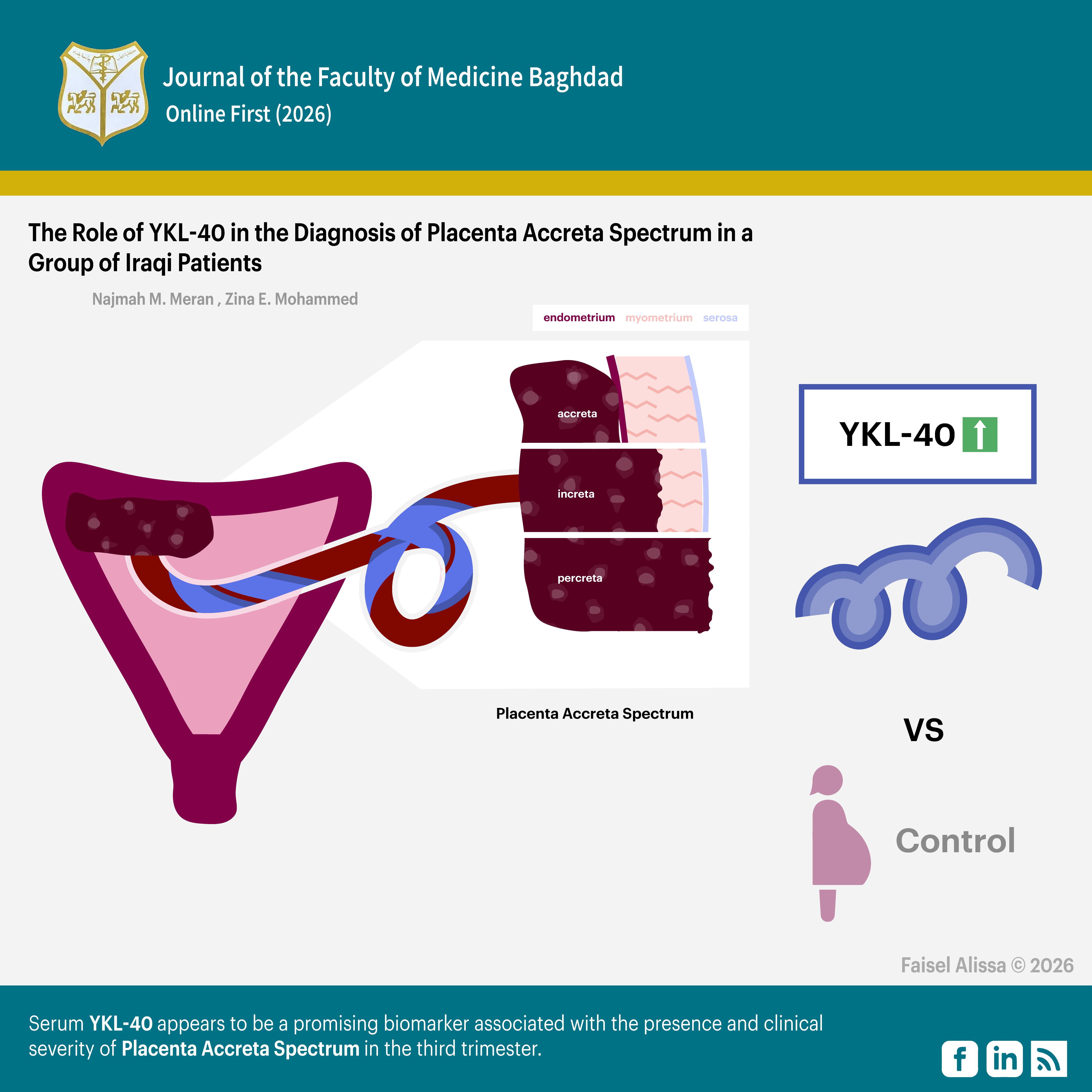
Background: As the number of caesarean deliveries has escalated over the last 50 years, Placenta Accreta Spectrum is now emerging as a more frequent pregnancy- related issue. The incidence of this problem is increasing, with recent estimates indicating an approximate 1/333 to 1/533 deliveries. Recent studies reveal that YKL-40 (also known as Chitinase-3-like protein 1 which is a secreted glycoprotein that is approximately 40kDa in size) may be involved in angiogenesis, cell proliferation and differentiation as well as extracellular matrix remodeling, and other inflammatory processes.
Objectives: To evaluate the association between maternal serum YKL-40 levels and the severity of Placenta Accreta Spectrum.
Methods: A case - control study was conducted in the Department of Obstetrics and Gynecology at Baghdad Teaching Hospital, Baghdad, from June 1, 2023, to June 1, 2024. It included 97 pregnant women with singleton pregnancy in the third trimester, having a diagnosis of Placenta Accreta Spectrum (37 patients), and those with normally sited placenta admitted for delivery either by vaginal or caesarean section (60 controls). The serum YKL40 biomarker was investigated in both groups.
Results: The mean level of the YKL-40 was significantly higher in patients diagnosed with placenta accreta spectrum than in those with a normal placenta. As the cut-off point for the YKL-40 is 112.68 pg/ml, a YKL-40 level > 112.68 pg/ml was associated with placenta accreta spectrum.
Conclusion: Serum YKL-40 appears to be a promising biomarker associated with the presence and clinical severity of Placenta Accreta Spectrum in the third trimester. While its role as a primary diagnostic tool is limited by the availability of imaging techniques at this stage of pregnancy, it shows a significant correlation with the depth of placental invasion.
y.
Received: Jan. 2026
Revised: Jan. 2026
Accepted: March 2026
Published Online: March 2026
Published: April 2026
Published: April 2026
References
Taskeen R, Shahwar D, Rafique I, et al. Reducing Mortality and Morbidity in Morbidly Adherent Placenta. Pakistan Journal of Medical and Health Sciences. 2022;16(2):935-7. https://doi.org/10.53350/pjmhs22162935
2. Kroener L, Wang E, Pisarska M. Predisposing Factors to Abnormal First Trimester Placentation and the Impact on Fetal Outcomes. Seminars in Reproductive Medicine. 2016;34(1):27-35. https://doi.org/10.1055/s-0035-1570029
3 . El-Sheikha ZK, Sedek AEH, El-Monsef A, et al. Serum Amyloid A as a novel marker to morbidly adherent placenta. Al-Azhar Medical Journal. 2020;49(2):437-46. https://doi.org/10.21608/amj.2020.68555
4. Jauniaux E, Zheng W, Yan J. Confirming the diagnosis and classifying placenta accreta spectrum (PAS) disorders: minutes of 2020 online international workshop on PAS in Beijing. Maternal-Fetal Medicine. 2021;3(4):229-31. https://doi.org/10.1097/FM9.0000000000000106
5. Blazevic N, Rogic D, Pelajic S, et al. YKL-40 as a biomarker in various inflammatory diseases: A review. Biochemia Medica. 2024;34(1). https://doi.org/10.11613/BM.2024.010502
6. Gybel‐Brask D, Johansen JS, Christiansen IJ, et al. Serum YKL‐40 and gestational diabetes - an observational cohort study. APMIS. 2016;124(9):770-5. https://doi.org/10.1111/apm.12573
7. Kietpeerakool C, Lumbiganon P, Laopaiboon M, et al. Pregnancy outcomes of women with previous caesarean sections: Secondary analysis of World Health Organization Multicountry Survey on Maternal and Newborn Health. Scientific Reports. 2019;9(1):9748. https://doi.org/10.1038/s41598-019-46153-4
8. Lee SU, Jo JH, Lee H, et al. A Multicenter, Retrospective Comparison Study of Pregnancy Outcomes According to Placental Location in Placenta Previa. Journal of Clinical Medicine. 2024;13(3):675. https://doi.org/10.3390/jcm13030675
9. Chamua B, Lalwani A, Najam R. An observational study on abnormal placentation in women with 2 or more previous cesarean sections in a tertiary care centre. The New Indian Journal of OBGYN. 2022; 8(2): 285 - 88. https://doi.org/10.21276/obgyn.2022.8.2.24
10. Tepe NB, Bayramoglu D, Taşkum İ. Elevated serum YKL-40 levels as a diagnostic and prognostic marker in the placenta accreta spectrum. Turkish Journal of Obstetrics and Gynecology. 2022;19(2):98-103.
https://doi.org/10.4274/tjod.galenos.2022.94884
11. Liu W, Wang R, Liu S, et al. YKL-40 promotes proliferation and invasion of HTR-8/SVneo cells by activating akt/MMP9 signalling in placenta accreta spectrum disorders. Journal of Obstetrics and Gynaecology.2023;43(1):2211681. https://doi.org/10.1080/01443615.2023.2211681
12. Karapinar OS, Sahin H, Gozukara I, et al. YKL-40 and fibronectin levels in patients with placental invasion anomaly. Ann Med Res. 2021;28(8):1440-4 . https://doi.org/10.5455/annalsmedres.2020.06.622
13. Gözükara I, Özgür T, Dolapçıoğlu K, et al.YKL 40 expression in abnormal invasive placenta cases. Journal of Perinatal Medicine. 2017;45(5):571-575. https://doi.org/10.1515/jpm-2016-0208
14. Amirabi A, Amjadipour N, Dinparast L. Diagnostic value of doppler ultrasonography in the diagnosis of morbidly adherent placenta. Journal of Obstetrics, Gynecology and Cancer Research. 2022;3(1):23-8. https://doi.org/10.21859/joqcr.3.1.23
15. Cali G, Forlani F, Foti F, et al. Diagnostic accuracy of first-trimester ultrasound in detecting abnormally invasive placenta in high-risk women with placenta previa. Ultrasound in obstetrics & gynecology. 2018;52(2):258-64. https://doi.org/10.1002/uog.19045
Downloads
Published
Issue
Section
Categories
License
Copyright (c) 2026 Najmah M. Meran, Zina E. Mohammed

This work is licensed under a Creative Commons Attribution 4.0 International License.













 Creative Commons Attribution 4.0 International license..