Laboratory Markers Used for the Diagnoses of Food, Respiratory, Skin, and Drug Allergies
DOI:
https://doi.org/10.32007/jfacmedbaghdad2411Keywords:
Drug Allergy, Food Allergy, Laboratory Markers, Respiratory Allergy, Skin AllergyAbstract
Background: Allergies, as prevalent conditions, significantly impact individuals' health and quality of life. The criticality of accurate diagnosis cannot be overstated, as it is the cornerstone for effective management and treatment, underscoring the gravity of the medical professionals’ work.
Objectives: This review aims to provide a comprehensive evaluation of laboratory markers used to diagnose different types of allergies, including food, respiratory, skin, and drug allergies.
Methods: The review analyzed and synthesized data from current literature on essential diagnostic tools such as skin prick tests, specific IgE blood tests, and component-resolved diagnostics. Studies comparing these diagnostic methods' efficacy, specificity, and limitations were discussed.
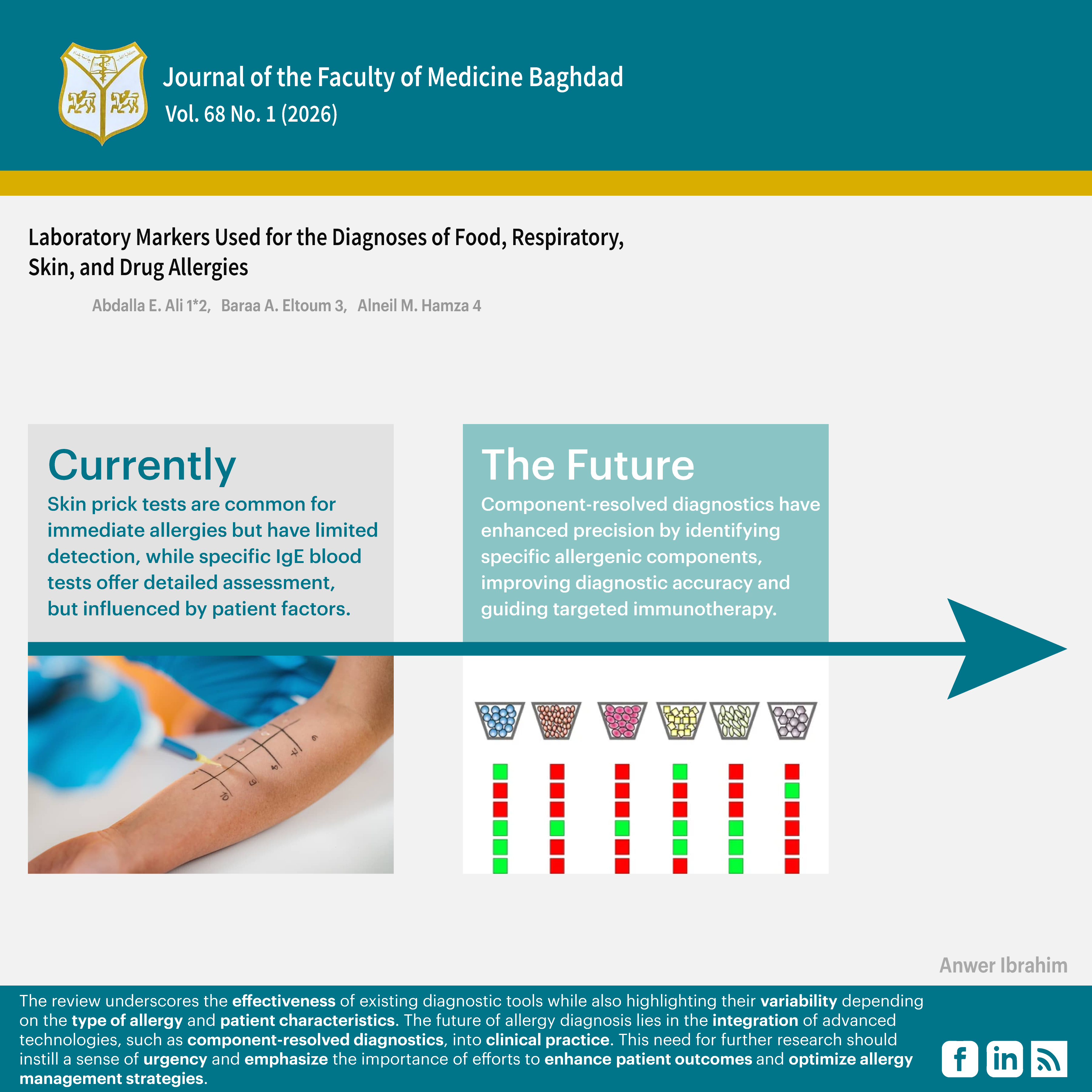
Results: Skin prick tests remain widely used for diagnosing immediate-type allergies but may have limitations in detecting all allergens. Specific IgE blood tests offer a more detailed assessment of allergen-specific responses, although they can be influenced by factors such as patient age and coexisting conditions. Component-resolved diagnostics provide enhanced precision by identifying specific allergenic components, potentially improving diagnostic accuracy and guiding targeted immunotherapy.
Conclusions: The review underscores the effectiveness of existing diagnostic tools while also highlighting their variability depending on the type of allergy and patient characteristics. The future of allergy diagnosis lies in the integration of advanced technologies, such as component-resolved diagnostics, into clinical practice. This need for further research should instill a sense of urgency and emphasize the importance of efforts to enhance patient outcomes and optimize allergy management strategies.
Received: Jun. 2024
Revised: Feb 2026
Accepted: March 2026
Published online: March 2026
Published: April 2026
References
1. Oriel RC, Sicherer SH. Skin prick testing for foods. Allergic and Immunologic Diseases.2022L 303-321. https://doi.org/10.1016/B978-0-323-95061-9.00010-2.
2. Traiyan S, Manuyakorn W, Kanchongkittiphon W, et al. Skin prick test versus phadiatop as a tool for diagnosis of allergic rhinitis in children. American Journal of Rhinology & Allergy. 2021 Jan;35(1):98-106. https://doi.org/10.1177/1945892420938300.
3. Anggraeni S, Umborowati MA, Endaryanto A, Sigit Prakoeswa CR. The Accuracy of Indonesian New Local Skin Prick Test (SPT) Allergen Extracts as Diagnostic Tool of IgE-mediated Atopic Dermatitis. IJFMT. 2021 Jul 1;15(3). https://doi.org/10.37506/ijfmt.v15i3.15965.
4. Callery EL, Keymer C, Barnes NA, Rowbottom AW. Component-resolved diagnostics in the clinical and laboratory investigation of allergy. Annals of Clinical Biochemistry. 2020 Jan;57(1):26-35. https://doi.org/10.1177/0004563219877434.
5. Barni S, Liccioli G, Sarti L, Giovannini M, Novembre E, Mori F. Immunoglobulin E (IgE)-mediated food allergy in children: epidemiology, pathogenesis, diagnosis, prevention, and management. Medicina. 2020 Mar 4;56(3):111. https://doi.org/10.3390/medicina56030111.
6. Calvani M, Anania C, Cuomo B, D'Auria E, Decimo F, Indirli GC, Marseglia G, Mastrorilli V, Sartorio MU, Santoro A, Veronelli E. Non-IgE-or mixed IgE/non-IgE-mediated gastrointestinal food allergies in the first years of life: Old and new tools for diagnosis. Nutrients. 2021 Jan 14;13(1):226. https://doi.org/10.3390/nu13010226.
7. Breiteneder H, Peng YQ, Agache I, et al. Biomarkers for diagnosis and prediction of therapy responses in allergic diseases and asthma. Allergy. 2020 Dec;75(12):3039-68. https://doi.org/10.1111/all.14582.
8. Caraballo L, Valenta R, Acevedo N, Zakzuk J. Are the terms major and minor allergens useful for precision allergology? Frontiers in immunology. 2021 Mar 8; 12:651500. https://doi.org/10.3389/fimmu.2021.651500.
9. Ogulur I, Pat Y, Ardicli O, Barletta E, et al. Fernandez. Santamaria R, Huang M, Bel Imam M, Koch J, Ma S, Maurer DJ. Advances and highlights in biomarkers of allergic diseases. Allergy. 2021 Dec;76(12):3659-86. https://doi.org/10.1111/all.15089.
10. Shamji MH, Valenta R, Jardetzky T, et al. The role of allergen‐specific IgE, IgG, and IgA in allergic disease. Allergy. 2021 Dec;76(12):3627-41. https://doi.org/10.1111/all.14908.
11. Satitsuksanoa P, Daanje M, Akdis M, Boyd SD, van de Veen W. Biology and dynamics of B cells in the context of IgE‐mediated food allergy. Allergy. 2021 Jun;76(6):1707-17. https://doi.org/10.1111/all.14684.
12. Chen Q, Xie M, Liu H, Dent AL. Developing allergen-specific IgE in a food-allergy model requires precisely timed B cell stimulation and is inhibited by Fgl2. Cell Rep. 2022 Jun 28;39(13):110990 https://doi.org/10.1016/j.celrep.2022.110990.
13. Foong RX, Santos AF. Biomarkers of diagnosis and resolution of food allergy. Pediatr Allergy Immunol. 2021 Feb;32(2):223-233. https://doi.org/10.1111/pai.13389.
14. Schoos AM, Bullens D, Chawes BL, et al. Immunological outcomes of allergen-specific immunotherapy in food allergy. Frontiers in Immunology. 2020 Nov 3; 11:568598. https://doi.org/10.3389/fimmu.2020.568598.
15. Zissler UM, Schmidt-Weber CB. I predict the success of allergen-specific immunotherapy. Front Immunol. 2020 Aug 25;11:1826. https://doi.org/10.3389/fimmu.2020.01826.
16. Knyziak-Mędrzycka I, Majsiak E, Cukrowska B. Allergic March in Children: The Significance of Precision Allergy Molecular Diagnosis (PAMD@) in Predicting Atopy Development and Planning Allergen-Specific Immunotherapy. Nutrients. 2023 Feb 15;15(4):978. https://doi.org/10.3390/nu15040978.
17. Zhao X, Zhang L, Wang J, Zhang M, Song Z, Ni B, You Y. Identification of key biomarkers and immune infiltration in systemic lupus erythematosus by integrated bioinformatics analysis. Journal of Translational Medicine. 2021 Dec;19:1-7. https://doi.org/10.1186/s12967-020-02698-x.
18. Ahmad A, Imran M, Ahsan H. Biomarkers as Biomedical Bioindicators: Approaches and Techniques for the Detection, Analysis, and Validation of Novel Biomarkers of Diseases. Pharmaceutics. 2023 May 31;15(6):1630. https://doi.org/10.3390/pharmaceutics15061630.
19. Fortino V, Wisgrill L, Werner P, et al. Machine-learning-driven biomarker discovery for the discrimination between allergic and irritant contact dermatitis. Proceedings of the National Academy of Sciences. 2020 Dec 29;117(52):33474-85. https://doi.org/10.1073/pnas.2009192117.
20. Tong DL, Kempsell KE, Szakmany T, Ball G. Development of a bioinformatics framework for identifying and validating genomic biomarkers and key immunopathology processes and controllers in infectious and non-infectious severe inflammatory response syndrome. Frontiers in Immunology. 2020 Mar 31; 11:380. https://doi.org/10.3389/fimmu.2020.00380.
21. Woo SD, Yang EM, Jang J, et al. Serum-free immunoglobulin E: a useful biomarker of atopy and type 2 asthma in adults with asthma. Annals of Allergy, Asthma & Immunology. 2021 Jul 1;127(1):109-15. https://doi.org/10.1016/j.anai.2021.03.023.
22. Crespo-Lessmann A, Curto E, Mateus E, et al. Total and specific immunoglobulin E in induced sputum in allergic and non-allergic asthma. PloS one. 2020 Jan 29;15(1):e0228045. https://doi.org/10.1371/journal.pone.0228045.
23. Kasumagic-Halilovic E. Total Serum Immunoglobulin E Levels in Patients with Psoriasis. Mater Sociomed. 2020 Jun;32(2):105-107. https://doi.org/10.5455/msm.2020.32.105-107.
24. Zhao Y, Zhang X, Jin H, et al. Histamine Intolerance-A Kind of Pseudoallergic Reaction. Biomolecules. 2022 Mar 15;12(3):454. https://doi.org/10.3390/biom12030454.
25. Babina M. The pseudo-allergic/neurogenic route of mast cell activation via MRGPRX2: Discovery, functional programs, regulation, relevance to disease, and relation with allergic stimulation. Itch. 2020 Apr 1;5(2): e32. https://doi.org/10.1097/itx.0000000000000032.
26. Uranga JA, Martínez V, Abalo R. Mast Cell Regulation and Irritable Bowel Syndrome: Effects of Food Components with Potential Nutraceutical Use. Molecules. 2020 Sep 20;25(18):4314. https://doi.org/10.3390/molecules25184314.
27. Azizah Z, Puspitasari I, Sahid MN. Drug-induced pseudoallergy reaction through mas-related G-protein-coupled receptor X2: A narrative review. The Thai Journal of Pharmaceutical Sciences. 2024 Mar;47(3):8. Chula https://doi.org/10.56808/3027-7922.2834.
28. Goodman RE, Chapman MD, Slater JE. The allergen: sources, extracts, and molecules for diagnosis of allergic disease. The Journal of Allergy and Clinical Immunology: In Practice. 2020 Sep 1;8(8):2506-14. https://doi.org/10.1016/j.jaip.2020.06.043.
29. Terlouw S, van Boven FE, Borsboom-van Zonneveld M, et al. Homemade Food Allergen Extracts for Use in Skin Prick Tests in the Diagnosis of IgE-Mediated Food Allergy: A Good Alternative in the Absence of Commercially Available Extracts?. Nutrients. 2022 Jan 21;14(3):475. https://doi.org/10.3390/nu14030475.
30. Mahler, V. Prick and Intracutaneous Testing and IgE Testing. In: John, S., Johansen, J., Rustemeyer, T., Elsner, P., Maibach, H. (eds) Kanerva's Occupational Dermatology. Springer, Cham.2022. pp 943-960 https://doi.org/10.1007/978-3-319-68617-2_84.
31. Elizur A, Goldberg MR. Pro: Skin prick testing with fresh foods. Ann Allergy Asthma Immunol. 2020 May;124(5):441-442. https://doi.org/10.1016/j.anai.2019.11.032.
32. Qiu C, Zhong L, Huang C, et al. Cell-bound IgE and plasma IgE are combined clinical diagnostic indicators for allergic patients. Scientific Reports. 2020 Mar 13;10(1):4700. https://doi.org/10.1038/s41598-020-61455-8.
33. Hu Y, Liu S, Liu P, Mu Z, Zhang J. Clinical relevance of eosinophils, basophils, serum total IgE level, allergen‐specific IgE, and clinical features in atopic dermatitis. Journal of Clinical Laboratory Analysis. 2020 Jun;34(6):e23214. https://doi.org/10.1002/jcla.23214.
34. Stokes J, Casale TB. The relationship between IgE and allergic disease. Uptodate. Available online: https://www.uptodate.com/contents/the-relationship-between-ige-and-allergic-disease.2022.
35. Liu Y, Li Y, Ma X, et al. Comparative analysis of serum total IgE levels and specific IgE levels in children aged 6 to 9 years with tic disorder and normal children. BMC Pediatr. 2023 Aug 14;23(1):399. https://doi.org/10.1186/s12887-023-04233-5.
36. Chapman MD. Analytical methods: immunoassays. Bioaerosols. 2020: 14. eBook ISBN9781003070078. https://doi.org/10.1201/9781003070078-11.
37. Akar-Ghibril N, Chang C. In vitro methods to assess allergy. Allergic and Immunologic Diseases. 2022, Pp: 323-344 https://doi.org/10.1016/B978-0-323-95061-9.00011-4.
38. Veloso-Teles R, Cerejeira R, Rodrigues D, Roque-Farinha R, von Buchwald C. Food-specific IgE and IgG antibodies in patients with chronic rhinosinusitis with nasal polyps: a case-control study. Ear, Nose & Throat Journal. 2021 Mar;100(3):177-84. https://doi.org/10.1177/0145561319867668.
39. Dierick BJ, van der Molen T, Flokstra-de Blok BM, et al, van Boven JF. Burden and socioeconomics of asthma, allergic rhinitis, atopic dermatitis, and food allergy. Expert review of pharmacoeconomics & outcomes research. 2020 Sep 2;20(5):437-53. https://doi.org/10.1080/14737167.2020.1819793.
40. Warren CM, Jiang J, Gupta RS. Epidemiology and Burden of Food Allergy. Curr Allergy Asthma Rep. 2020 Feb 14;20(2):6. https://doi.org/10.1007/s11882-020-0898-7.
41. Ha J, Lee SW, Yon DK. Ten-year trends and prevalence of asthma, allergic rhinitis, and atopic dermatitis among the Korean population, 2008-2017. Clin Exp Pediatr. 2020 Jul;63(7):278-283. https://doi.org/10.3345/cep.2019.01291.
42. Ansotegui IJ, Melioli G, Canonica GW, Caraballo L, Villa E, Ebisawa M, Passalacqua G, Savi E, Ebo D, Gómez RM, Sánchez OL. IgE allergy diagnostics and other relevant tests in allergy, a World Allergy Organization position paper. World Allergy Organization Journal. 2020 Feb 1;13(2):100080. https://doi.org/10.1016/j.waojou.2019.100080.
43. Zhang Y, Lan F, Zhang L. Advances and highlights in allergic rhinitis. Allergy. 2021 Nov;76(11):3383-3389. https://doi.org/10.1111/all.15044.
44. Panaitescu C, Haidar L, Buzan MR, et al. Precision medicine in the allergy clinic: the application of component resolved diagnosis. Expert Review of Clinical Immunology. 2022 Feb 1;18(2):145-62. https://doi.org/10.1080/1744666X.2022.2034501.
45. Sookrung N, Tungtrongchitr A, Chaicumpa W. Cockroaches: Allergens, component-resolved diagnosis (CRD) and component-resolved immunotherapy. Current Protein and Peptide Science. 2020 Feb 1;21(2):124-41. https://doi.org/10.2174/1389203720666190731144043.
46. Hamilton RG, Hemmer W, Nopp A, Kleine-Tebbe J. Advances in IgE testing for diagnosis of allergic disease. The Journal of Allergy and Clinical Immunology: In Practice. 2020 Sep 1;8(8):2495-504. https://doi.org/10.1016/j.jaip.2020.07.021.
47. Giannitsis E, Mueller-Hennessen M, Zeller T, Schuebler A, et al. Gender-specific reference values for high-sensitivity cardiac troponin T and I in well-phenotyped healthy individuals and validity of high-sensitivity assay designation. Clinical Biochemistry. 2020 Apr 1;78:18-24. https://doi.org/10.1016/j.clinbiochem.2019.11.013.
48. Albert C, Zapf A, Haase M, et al. Neutrophil gelatinase-associated lipocalin measured on clinical laboratory platforms for the prediction of acute kidney injury and the associated need for dialysis therapy: a systematic review and meta-analysis. American Journal of Kidney Diseases. 2020 Dec 1;76(6):826-41. https://doi.org/10.1053/j.ajkd.2020.05.015.
49. Peng J, Qi D, Yuan G, et al. Diagnostic value of peripheral hematologic markers for coronavirus disease 2019 (COVID‐19): a multicenter, cross‐sectional study. Journal of clinical laboratory analysis. 2020 Oct;34(10): e23475. https://doi.org/10.1002/jcla.23475.
50. Di Tommaso M, Luciani A, Crisi PE, et al. Detection of serum allergen-specific IgE in atopic dogs tested in northern Italy: Preliminary study. Animals. 2021 Feb 1;11(2):358. https://doi.org/10.3390/ani11020358.
51. Foong RX, Dantzer JA, Wood RA, Santos AF. Improving diagnostic accuracy in food allergy. The Journal of Allergy and Clinical Immunology: In Practice. 2021 Jan 1;9(1):71-80. https://doi.org/10.1016/j.jaip.2020.09.037.
52. Koch L, Laipold K, Arzt‐Gradwohl L, et al. Molecular allergy diagnosis is sensitive and avoids misdiagnosis in patients sensitized to seasonal allergens. Clinical and Translational Allergy. 2023 Mar;13(3):e12231. https://doi.org/10.1002/clt2.12231.
53. Grobman L, Kitsen J, Mortazavi D, Geng B. Correlation of skin prick testing to environmental allergens. Annals of Allergy, Asthma & Immunology. 2021 Apr 1;126(4):378-84. https://doi.org/10.1016/j.anai.2020.10.010.
54. Harding BC, Kinealy BP, Franzese CB. Cross-reactivity in Skin Prick Test Results of Members Within Pooideae Subfamily. OTO Open. 2021 Jan 13;5(1):2473974X20986569. https://doi.org/10.1177/2473974X20986569.
55. Koch L, Laipold K, Arzt-Gradwohl L, Sturm EM, Aberer W, Aumayr M, Hemmer W, Čerpes U, Sturm GJ. Molecular allergy diagnosis is sensitive and avoids misdiagnosis in patients sensitized to seasonal allergens. Clin Transl Allergy. 2023 Mar;13(3):e12231. https://doi.org/10.1002/clt2.12231.
56. Diem L, Neuherz B, Rohrhofer J, Koidl L, Asero R, Brockow K, Diaz Perales A, Faber M, Gebhardt J, Torres MJ, Jensen‐Jarolim E. Real‐life evaluation of molecular multiplex IgE test methods in the diagnosis of pollen associated food allergy. Allergy. 2022 Oct;77(10):3028-40. https://doi.org/10.1111/all.15329.
57. Hemmings O, Niazi U, Kwok M, Radulovic S, Du Toit G, Lack G, Santos AF. Combining allergen components improves the accuracy of peanut allergy diagnosis. The Journal of Allergy and Clinical Immunology: In Practice. 2022 Jan 1;10(1):189-99. https://doi.org/10.1016/j.jaip.2021.08.029.
58. Thorpe M, Movérare R, Fischer C, Lidholm J, Rudengren M, Borres MP. History and utility of specific IgE cutoff levels: What is the relevance of allergy diagnosis? JACI: In Practice. 2023 Oct 1;11(10):3021-9. https://doi.org/10.1016/j.jaip.2023.05.022.
59. Goyard S, Balbino B, Chinthrajah RS, et al. A highly sensitive bioluminescent method for measuring allergen‐specific IgE in microliter samples. Allergy. 2020 Nov;75(11):2952-6. https://doi.org/10.1111/all.14365.
60. Karsonova A, Riabova K, Villazala‐Merino S, Campana R, Niederberger V, Eckl‐Dorna J, Froeschl R, et al. Highly sensitive ELISA‐based assay for quantification of allergen‐specific IgE antibody levels. Allergy. 2020 Oct;75(10):2668. https://doi.org/10.1111/all.14325.
61. Kucuksezer UC, Ozdemir C, Cevhertas L, Ogulur I, Akdis M, Akdis CA. Mechanisms of allergen-specific immunotherapy and allergen tolerance. Allergology International. 2020;69(4):549-60. https://doi.org/10.1016/j.alit.2020.08.002.
62. Dorofeeva Y, Shilovskiy I, Tulaeva I, Focke‐Tejkl M, Flicker S, Kudlay D, Khaitov M, Karsonova A, Riabova K, Karaulov A, Khanferyan R. Past, present, and future of allergen immunotherapy vaccines. Allergy. 2021 Jan;76(1):131-49. https://doi.org/10.1111/all.14300.
63. Alvaro‐Lozano M, Akdis CA, Akdis M, Alviani C, Angier E, Arasi S, Arzt‐Gradwohl L, Barber D, Bazire R, Cavkaytar O, Comberiati P. Allergen immunotherapy in children user's guide. Pediatric allergy and immunology. 2020 May;31:1-01. https://doi.org/10.1111/pai.13189.
64. Keshavarz B, Platts-Mills TA, Wilson JM. The use of microarray and other multiplex technologies in the diagnosis of allergy. Annals of Allergy, Asthma & Immunology. 2021 Jul 1;127(1):10-8. https://doi.org/10.1016/j.anai.2021.01.003.
65. Huang HJ, Campana R, Akinfenwa O, et al. Microarray-based allergy diagnosis: quo vadis?. Frontiers in immunology. 2021 Feb 12;11:594978. https://doi.org/10.3389/fimmu.2020.594978.
66. Smiljkovic D, Kiss R, Lupinek C, et al. Microarray-based detection of allergen-reactive IgE in patients with mastocytosis. The Journal of Allergy and Clinical Immunology: In Practice. 2020 Sep 1;8(8):2761-8. https://doi.org/10.1016/j.jaip.2020.04.030.
Downloads
Published
Issue
Section
Categories
License
Copyright (c) 2026 Abdalla E. Ali; Baraa A. Eltoum; Alneil M. Hamza

This work is licensed under a Creative Commons Attribution 4.0 International License.














 Creative Commons Attribution 4.0 International license..