Comparisons of serum CTLA-4 levels between treated and Untreated SCLC and NSCLC Patients
DOI:
https://doi.org/10.32007/jfacmedbaghdad3260Keywords:
Complete blood count, Cytotoxic T-lymphocyte-associated antigen 4, Non-small cell lung cancer, Programmed death-ligand 1, Small cell lung cancerAbstract
Background: Small cell lung cancer and non-small cell lung cancer are the two main types of lung cancer and major causes of cancer-related death worldwide.
Objectives: To compare serum cytotoxic T-lymphocyte-associated antigen 4 levels between treated and untreated patients with small cell lung cancer and non-small cell lung cancer, and healthy controls.
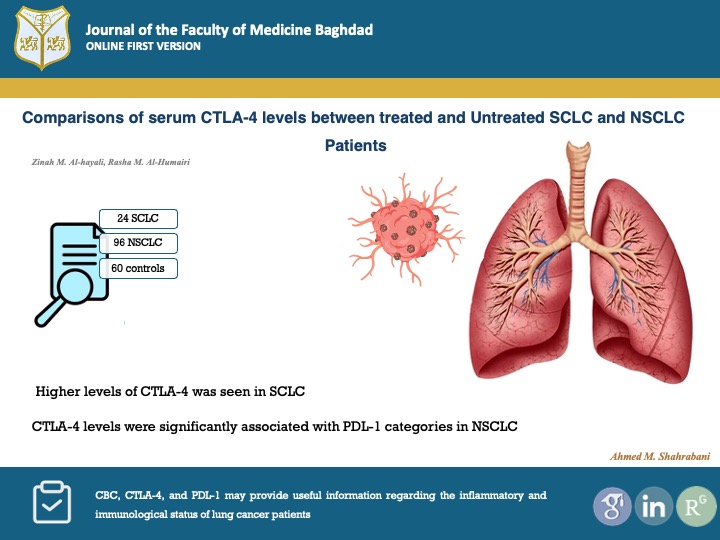
Methods: This case-control study was conducted at the Oncology Teaching Hospital, Baghdad, Iraq, from December 2024 to June 2025. The study included 180 participants: 24 patients with small cell lung cancer, 96 with non-small cell lung cancer, and 60 healthy controls. Serum cytotoxic T-lymphocyte-associated antigen 4 levels were measured using enzyme-linked immunosorbent assay, and complete blood count parameters were measured using an automated hematology analyzer.
Results: Cytotoxic T-lymphocyte-associated antigen 4 levels differed significantly among the control, small cell lung cancer, and non-small cell lung cancer groups (p = 0.02), with higher levels in small cell lung cancer and lower levels in non-small cell lung cancer than controls. No significant differences were observed between treated and untreated patients in either group. Cytotoxic T-lymphocyte-associated antigen 4 levels were significantly associated with Programmed death-ligand 1 categories in treated non-small cell lung cancer patients (p = 0.01), but not in untreated patients (p = 0.12). Complete blood count parameters differed significantly among the study groups, suggesting systemic inflammatory changes. Serum cytotoxic T-lymphocyte-associated antigen 4 showed limited diagnostic performance.
Conclusion: Cytotoxic T-lymphocyte-associated antigen 4 levels were significantly associated with Programmed death-ligand 1 expression in treated patients. Complete blood count, cytotoxic T-lymphocyte-associated antigen 4, and Programmed death-ligand 1 may provide useful information on the inflammatory and immunological status of lung cancer patients, but further studies are needed to confirm their clinical significance.
Received: 2nd Jan. 2026,
Revised:15 April 2026,
Accepted:25 May 2026,
Published Online: June 2026,
Published 01 July 2026
Downloads
References
1. Al-Hashimi MM, Alawjar MQY. Trends in lung cancer incidence in Iraq during the period. Int J Public Health. 2024;13(3):1063-1070. https://doi.org/10.11591/ijphs.v13i3.23819
2. Mariean CR, Tiuca OM, Mariean A, et al. Variation in CBC-Derived Inflammatory Biomarkers Across Histologic Subtypes of Lung Cancer: Can Histology Guide Clinical Management?. Diagnostics. 2025;15(11):1437. https://doi.org/10.3390/diagnostics15111437
3. Cheng W, Kang K, Zhao A, et al. Dual blockade immunotherapy targeting PD-1/PD-L1 and CTLA-4 in lung cancer. Journal of Hematology & Oncology. 2024;17(1):54.
https://doi.org/10.1186/s13045-024-01581-2
4. Acheampong E, Abed A, Morici M, et al. Tumour PD-L1 expression in small-cell lung cancer: a systematic review and meta-analysis. Cells. 2020;9(11):2393. https://doi.org/10.3390/cells9112393
5. Shen K, Cui J, Wei Y, et al. Effectiveness and safety of PD-1/PD-L1 or CTLA4 inhibitors combined with chemotherapy as a first-line treatment for lung cancer: A meta-analysis. Journal of Thoracic Disease. 2018;10(12):6636. https://doi.org/10.21037/jtd.2018.11.72
6. Kwiecien I, Skirecki T, Polubiec-Kownacka M, et al. Immunophenotype of T cells expressing programmed death-1 and cytotoxic T cell antigen-4 in early lung cancer: local vs. systemic immune response. Cancers. 2019;11(4):567. https://doi.org/10.3390/cancers11040567
7. Rybak J, Magiera B, Magiera K, et al. Lung cancer: risk factors and prevention strategies-overview of the literature. Archiv Euromedica. 2024;14(3):344. https://doi.org/10.35630/2024/14/3.344
8. Yoshida K, Gowers KHC, Lee-Six H, et al. Tobacco smoking and somatic mutations in human bronchial epithelium. Nature. 2020;578:266–272. https://doi.org/10.1038/s41586-020-1961-1
9. Siddiqui F, Vaqar S, Siddiqui AH. Lung cancer. In: StatPearls [Internet]. Treasure Island (FL): StatPearls Publishing; 2025 Jan-. Available from: https://www.ncbi.nlm.nih.gov/books/NBK482357/
10. Zhou J, Xu Y, Liu J, et al. Global burden of lung cancer in 2022 and projections to 2050: incidence and mortality estimates from GLOBOCAN. Cancer Epidemiology. 2024;93:102693. https://doi.org/10.1016/j.canep.2024.102693
11. Stapelfeld C, Dammann C, Maser E. Sex-specificity in lung cancer risk. International Journal of Cancer. 2020;146(9):2376-2382. https://doi.org/10.1002/ijc.32716
12. Kehrle K, Hetjens M, Hetjens S. Risk factors and preventive measures for lung cancer in the European Union. Epidemiologia. 2024;5(3):539-546. https://doi.org/10.3390/epidemiologia5030037
13. Sharma K, Saini K, Chimaniya P, et al. Lung Cancer therapy: synergistic potential of PD-1/PD-L1 and CTLA-4 inhibitors. In: Bhatt S, Eri R, Goh BH, Paudel KR, Andreoli Pinto Tdj, Dua K, editors. Immunotherapy Against Lung Cancer: Emerging Opportunities and Challenges. Singapore: Springer Nature Singapore; 2024. p.297-316. https://doi.org/10.1007/978-981-99-7141-1_15
14. Carvajal-Hausdorf D, Altan M, Velcheti V, et al. Expression and clinical significance of PD-L1, B7-H3, B7-H4 and TILs in human small cell lung Cancer (SCLC). Journal for Immunotherapy of Cancer. 2019;7(1):65.
https://doi.org/10.1186/s40425-019-0540-1
15. Kwiecien I, Stelmaszczyk-Emmel A, Polubiec-Kownacka M, et al. Elevated regulatory T cells, surface and intracellular CTLA-4 expression and interleukin-17 in the lung cancer microenvironment in humans. Cancer Immunology Immunotherapy. 2017;66(2):161-170. https://doi.org/10.1007/s00262-016-1930-6
16. Liu C, Jing W, An N, et al. Prognostic significance of peripheral CD8+ CD28+ and CD8+ CD28− T cells in advanced non-small cell lung cancer patients treated with chemo (radio) therapy. Journal of Translational Medicine. 2019;17(1):344. https://doi.org/10.1186/s12967-019-2097-6
17. Zhang H, Dutta P, Liu J, et al. Tumour cell-intrinsic CTLA4 regulates PD-L1 expression in non-small cell lung cancer. Journal of Cellular and Molecular Medicine. 2019;23(1):535-542. https://doi.org/10.1111/jcmm.13956
18. Domagala-Kulawik J. The role of the immune system in non-small cell lung carcinoma and potential for therapeutic intervention. Translational Lung Cancer Research. 2015;4(2):177. https://doi.org/10.3978/j.issn.2218-6751.2015.01.11.
19. Maung TZ, Ergin HE, Javed M, et al. Immune checkpoint inhibitors in lung cancer: role of biomarkers and combination therapies. Cureus. 2020;12(5):e8095. https://doi.org/10.7759/cureus.8095
20. Onoi K, Chihara Y, Uchino J, et al. Immune checkpoint inhibitors for lung cancer treatment: a review. Journal of Clinical Medicine. 2020;9(5):1362. https://doi.org/10.3390/jcm9051362
21. Vornicu VN, Negru AG, Vonica RC, et al. Site-specific inflammatory signatures in metastatic NSCLC: insights from routine blood count parameters. Medicina. 2025;61(9):1521. https://doi.org/10.3390/medicina61091521
22. Shoji F, Kozuma Y, Toyokawa G, et al. Complete blood cell count-derived inflammatory biomarkers in early-stage non-small-cell lung cancer. Annals of Thoracic and Cardiovascular Surgery. 2020;26(5):248-255. https://doi.org/10.5761/atcs.oa.19-00315
23. Tostes K, Dias TC, Rebolho GK, et al. Monocyte-Platelet-Hemoglobin-Hematocrit score and the role of hematological parameters in predicting treatment response to immune checkpoint inhibitors and survival outcomes in non-small cell lung cancer patients. Translational Lung Cancer Research. 2025;14(9):3623-3635. https://doi.org/10.21037/tlcr-2025-179
24. Gaur P, Bhattacharya S, Kant S, et al. Hospital-based study on demographic, hematological, and biochemical profile of lung cancer patients. Journal of Cancer Research and Therapeutics. 2020;16(4):838-842. https://doi.org/10.4103/jcrt.JCRT_185_18
25. Mariean CR, Tiuca OM, Mariean A, et al. The impact of histologic types of lung cancer on CBC-derived inflammatory markers: current knowledge and future perspectives. Journal of Clinical Medicine. 2025;14(9):3038. https://doi.org/10.3390/jcm14093038
26. Tas F, Ozturk A, Erturk K. Clinical significances of variations in main hematological parameters at the time of diagnosis in patients with small cell lung cancer. Oncology in Clinical Practice. 2026;22:e00526080. https://doi.org/10.5603/ocp.108418
Downloads
Published
Issue
Section
Categories
License
Copyright (c) 2026 Zinah Al-Hayali, Rasha M. Al-Humairi

This work is licensed under a Creative Commons Attribution 4.0 International License.














 Creative Commons Attribution 4.0 International license..