Prevalence of Obsessive-Compulsive Disorder Symptoms in a Sample of Medical Students in Iraq
DOI:
https://doi.org/10.32007/jfacmedbaghdad2165Keywords:
Medical Students, Obsessive compulsive symptoms, Revised Arabic Scale of Obsession-CompulsionAbstract
Background: Obsessive-compulsive disorders (OCD) is a common mental health condition where a person has obsessive thoughts and compulsive behaviors. The worldwide prevalence of OCD is approximately 2% of the general population.
Objective: To assess prevalence of obsessive-compulsive disorder symptoms in a sample of medical students in Iraq.
Methods: A cross-sectional study design with a convenience sampling method, was conducted on 414 Iraqi medical students during
the period from 1st November, 2022 to 28th February, 2023. Data were collected using a structured questionnaire submitted online. The questionnaire consisted of two parts: The first included socio-demographic characteristics (age, gender, college year, residence, marital status) and risk factors, whereas the second part consisted of 20 items from the Revised Arabic Scale of Obsession-Compulsion.
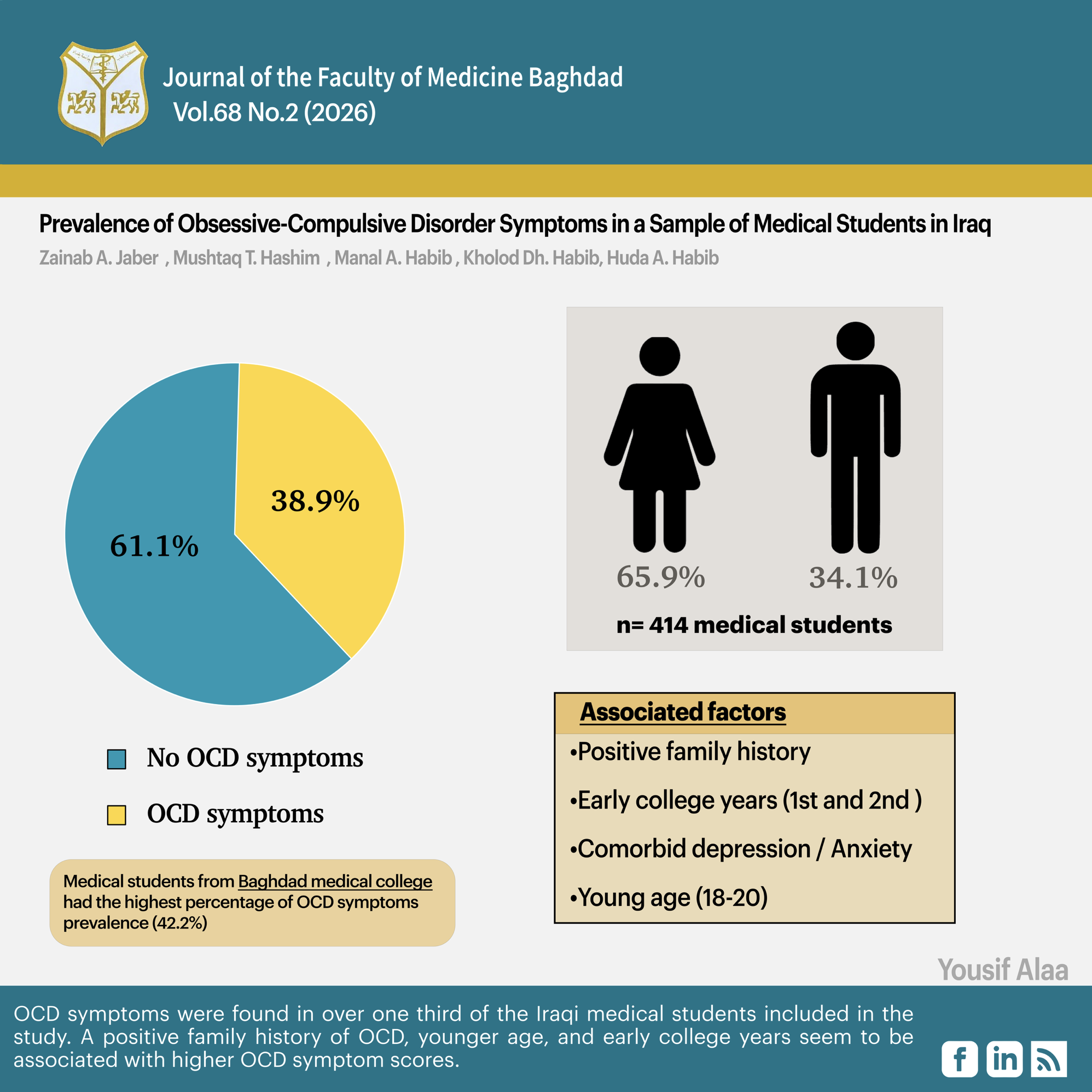
Results: It was found that (38.9%) of participants had OCD symptoms. The overall weighted mean and standard deviation, was 2.13 ± 0.599, so any mean equal to or exceeding this value was highly indicative of OCDthe cut-off point). Significant associations were found between positive family history of OCD, age, college year, and OCD symptom score.
Conclusion: OCD symptoms were found in over one third of the Iraqi medical students included in the study. A positive family history of OCD, younger age, and early college years seem to be associated with higher OCD symptom scores.
Received: May 2025
Revised: April 2026
Accepted: May 2026
Published Online: May 2026
References
1. Carmi L, Brakoulias V, Arush OB, et al. A prospective clinical cohort-based study of the prevalence of OCD, obsessive compulsive and related disorders, and tics in families of patients with OCD. BMC Psychiatry. 2022 Mar 17;22(1):190. https://doi.org/10.1186/s12888-022-03807-4.
2. Fawcett EJ, Power H, Fawcett JM. Women Are at Greater Risk of OCD Than Men: A Meta-Analytic Review of OCD Prevalence Worldwide. J Clin Psychiatry. 2020 Jun 23;81(4):19r13085. https://doi.org/10.4088/JCP.19r13085.
3. Pampaloni I, Marriott S, Pessina E, et al. The global assessment of OCD. Compr Psychiatry. 2022 Oct;118:152342. https://doi.org/10.1016/j.comppsych.2022.152342.
4. Bandelow B, Allgulander C, Baldwin DS, et al. World Federation of Societies of Biological Psychiatry (WFSBP) guidelines for treatment of anxiety, obsessive-compulsive and posttraumatic stress disorders–Version 3. Part I: Anxiety disorders. The World Journal of Biological Psychiatry. 2023 Feb 7;24(2):79-117. https://doi.org/10.1080/15622975.2022.2086295.
5. American Psychiatric Association. Diagnostic and statistical manual of mental disorders. 5th ed. Arlington, VA: American Psychiatric Press; 2013. 235-264 https://doi.org/10.4103/0019-5545.117131.
6. Geddes JR, Andreasen NC, Goodwin GM, editors. New Oxford textbook of psychiatry. Oxford University Press 3rded; 2020. 765–774. https://doi.org/10.1093/med/9780198713005.001.0001.
7. Taher TMJ, Al-fadhul SAL, Abutiheen AA, et al. Prevalence of obsessive-compulsive disorder (OCD) among Iraqi undergraduate medical students in time of COVID-19 pandemic. Middle East Current Psychiatry.2021; 28(1), 1-8. https://doi.org/10.1186/s43045-021-00086-9.
8. Abas N, Qasim S. Prevalence of Obsessive-Compulsive Disorder Among Psychology Students. Journal of Garmian University, 2023; 10(1): 274-283. https://doi.org/10.24271/jgu.2023.101023.
9. Hama R, Ahmed N. Obsessive compulsive symptoms among students of Faculty of Medical Sciences and Faculty of Humanities Education in University of Sulaimani. Journal of Sulaimani Medical College. 2018; 8(4), 299-305. https://doi.org/10.17656/jsmc.10182.
10. Alhasnawi S, Sadik S, Rasheed M, et al. Iraq Mental Health Survey Study Group. The prevalence and correlates of DSM-IV disorders in the Iraq Mental Health Survey (IMHS). World Psychiatry. 2009 Jun;8(2):97-109. https://pmc.ncbi.nlm.nih.gov/articles/PMC2694515/.
11. Abdel-Khalek A. The Construction and Validation of the Revised Arabic Scale of Obsession Compulsion (ASOC). Online Journal of Neurology and Brain Disorders. 2018;1(2): 1-7. https://doi.org/10.32474/OJNBD.2018.01.000109.
12. Alblowy AA. M. Assessment of Obsessive-Compulsive Disorder among Nursing Students in Al Riyada College in Jeddah and its Relationship to Some Variables. International Journal of Nursing Education. 2022;14(2), 34-44. https://doi.org/10.37506/ijone.v14i2.17985.
13. Almutairi AM, Aladhadh KM, Alsayed SA, et al. Prevalence of obsessive-compulsive disorder symptoms among medical students. International Journal of Medicine in Developing Countries. 2021;5(5), 1183-1183. https://doi.org/10.24911/IJMDC.51-1616952490.
14. Khalaf AM, Alshuaibi SK, Bin FB, et al. The prevalence of obsessive-compulsive disorder and symptoms among medical students: A perspective study from Riyadh, Saudi Arabia. Med Sci. 2021; 25(114), 2088-95. https://discoveryjournals.org/medicalscience/current_issue/v25/n114/A37.pdf.
15. SoleimanvandiAzar N, Amirkafi A, Shalbafan M, et al. Prevalence of obsessive-compulsive disorders (OCD) symptoms among health care workers in COVID-19 pandemic: a systematic review and meta-analysis. BMC psychiatry. 2023; 23(1), 862. https://doi.org/10.1186/s12888-023-05353-z.
16. Fontenelle LF, Muhlbauer JE, Albertella L, et al. Traumatic and stressful life events in hoarding: the role of loss and deprivation. Eur J Psychotraumatol. 2021 Jul 22;12(1):1947002. https://doi.org/10.1080/20008198.2021.1947002.
17. Goessmann K, Ibrahim H, Neuner F. Association of war-related and gender-based violence with mental health states of Yazidi women. JAMA network open. 2020; 3(9): e2013418. https://doi.org/10.1001/jamanetworkopen.2020.13418.
18. Salami B, Iwuagwu S, Amodu O, et al. The health of internally displaced children in sub-Saharan Africa: a scoping review. BMJ Global Health. 2020; 5(8), e002584. https://doi.org/10.1136/bmjgh-2020-002584.
19. Linde ES, Varga TV, Clotworthy A. Obsessive-compulsive disorder during the COVID-19 pandemic—a systematic review. Frontiers in psychiatry. 2022;13, 806872. https://doi.org/10.3389/fpsyt.2022.806872.
20. Grant JE, Drummond L, Nicholson TR, et al. Obsessive-compulsive symptoms and the Covid-19 pandemic: A rapid scoping review. Neuroscience & Biobehavioral Reviews. 2022; 132, 1086-1098. https://doi.org/10.1016/j.neubiorev.2021.10.039.
21. Davoudi M, Sadoughi M, Pourshahbaz A, et al. Exploring the structure of the university-students obsessive–compulsive tendency scale in Iranian university students: a network analysis study. BMC Research Notes. 2023; 16(1), 193. https://doi.org/10.1186/s13104-023-06474-0.
22. Moh’d A S. Obsessive-compulsive symptom prevalence among university students and associated demographic variables. Arab Journal of Psychiatry. 2021;32(1):79-85. https://doi.org/10.12816/0058768.
23. Sultan S, Fallata EO, Bashar MA, et al. Prevalence, socio demographic and academic correlates of obsessive-compulsive disorder in the students of college of applied medical sciences, Umm Al-Qura university. Journal of Obsessive-Compulsive and Related Disorders. 2021;28:100604. https://doi.org/10.1016/j.jocrd.2020.100604.
24. Jaisoorya TS, Janardhan Reddy YC, Nair BS, et al. Prevalence and correlates of obsessive-compulsive disorder and sub threshold obsessive-compulsive disorder among college students in Kerala, India. Indian J Psychiatry. 2017 Jan-Mar;59(1):56-62. https://doi.org/10.4103/0019-5545.204438.
25. Torres AR, Cruz BL, Vicentini HC, et al. Obsessive-Compulsive Symptoms in Medical Students: Prevalence, Severity, and Correlates. Acad Psychiatry. 2016 Feb;40(1):46-54. https://doi.org/10.1007/s40596-015-0357-2.
26. Pacheco JP, Giacomin HT, Tam WW, et al. Mental health problems among medical students in Brazil: a systematic review and meta-analysis. Braz J Psychiatry. 2017 Oct-Dec;39(4):369-378. https://doi.org/10.1590/1516-4446-2017-2223.
27. Backović DV, Maksimović M, Davidović D, et al. Stress and mental health among medical students. Srp Arh Celok Lek. 2013 Nov-Dec;141(11-12):780-4. Serbian. https://doi.org/10.2298/sarh1312780b.
28. Hankir AK, Northall A, Zaman R. Stigma and mental health challenges in medical students. BMJ Case Rep. 2014 Sep 2;2014:bcr2014205226. https://doi.org/10.1136/bcr-2014-205226.
29. Sheldon E, Simmonds-Buckley M, Bone C, et al. Prevalence and risk factors for mental health problems in university undergraduate students: A systematic review with meta-analysis. J Affect Disord. 2021 May 15;287:282-292. https://doi.org/10.1016/j.jad.2021.03.054.
30. Jaber ZA, Salman RT, Abid Al Wahab DY, et al. Assessment of the Depression Level among Medical Students at University of Baghdad, College of Medicine. Al-Kindy Col. Med. J [Internet]. 2021 Dec. 30 ;17(3):175-9. https://doi.org/10.47723/kcmj.v17i3.248.
31. Al-Hemiary NJ, Al-Hasnawi SM. Seeking Help from Faith Healers among Iraqi Patients with Obsessive – Compulsive Disorder. J Fac Med Bagdad. 2010 Jan. 3;51(4):385-7. https://doi.org/10.32007/jfacmedbagdad.5141089.











 Creative Commons Attribution 4.0 International license..