Circulating Levels of GLP-1 and AGEs in a Group of Iraqi Women with Polyendocrine Metabolic Ovarian Syndrome: A Case-Control Study
DOI:
https://doi.org/10.32007/jfacmedbaghdad3306Keywords:
Advanced Glycation End Products, Glucagon-Like Peptide-1, HOMA-IR, Hyperandrogenism, Polyendocrine Metabolic Ovarian Syndrome, PMOSAbstract
Background: Polyendocrine metabolic ovarian syndrome (PMOS) is a common condition that affects women of reproductive age. It is usually associated with hormonal and metabolic disorders. However, the precise relationship between these derangements and the development of PMOS is unclear.
Objectives: To evaluate the circulatory levels of Glucagon-Like Peptide-1 (GLP-1) and Advanced Glycation End-products (AGEs) in PMOS and to explore the possible application of these factors as potential diagnostic biomarkers.
Methods: A case-control study was conducted at the College of Science, University of Baghdad, between Nov. 2024 and Feb. 2025. The study involved 90 Iraqi women aged 18-45 years, divided into two groups: 50 women who had recently been diagnosed with PMOS and 40 healthy women as controls. Hormonal profiles and metabolic parameters (GLP-1 and AGEs) were measured in all participants.
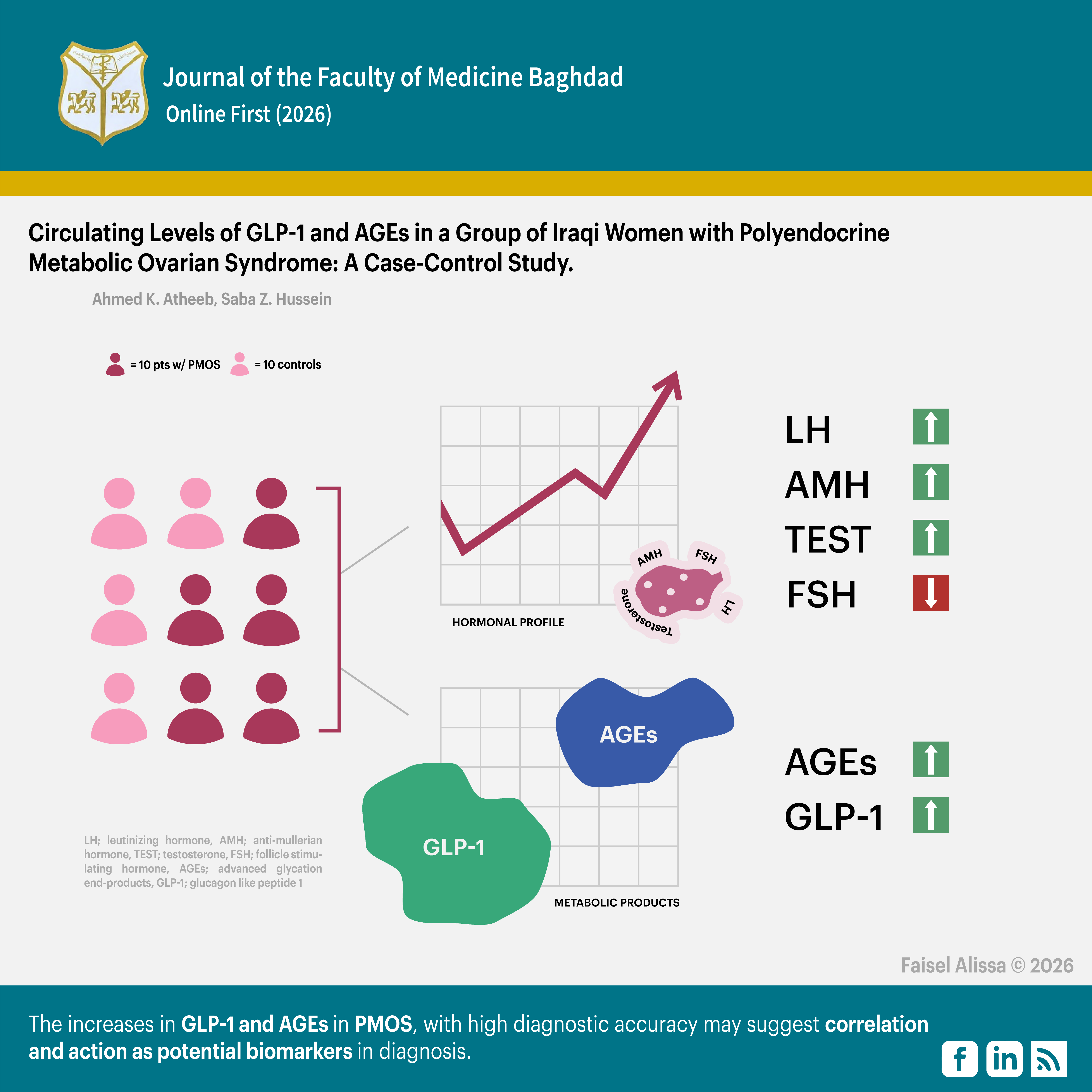
Results: Women with PMOS had an elevated hormonal profile, characterized by higher concentrations of LH, an LH/FSH ratio, testosterone, and Anti-Müllerian Hormone (AMH), along with a considerable drop in FSH compared to the control group. They also showed significant elevations in metabolic parameters (AGEs and GLP-1) compared to the control group. GLP-1 and AGEs had an area under the curve (AUC) of 1.000, with 100% sensitivity and 100% specificity, indicating their diagnostic value.
Conclusions: The increase in GLP-1 and AGEs reveals hormonal-metabolic dysregulation, indicating a high degree of correlation in the complexity and progression of the disease. The high diagnostic accuracy of GLP-1 and AGEs in PMOS, may suggest that they are potential biomarkers for diagnosing the disease.
Received: 27 Jan. 2026,
Revised:3 May 2026,
Accepted:17 May 2026,
Published Online: May 2026
Published: 01 July 2026
Downloads
References
1. Tewari S, Khalua RK, Parida S. Redefining polycystic ovary syndrome (PCOS) as polyendocrine metabolic ovarian syndrome (PMOS): Implications for diagnosis, pathophysiology and clinical management. International Journal of Gynaecology Sciences. 2026;8(1):17-25. https://www.doi.org/10.33545/26648393.2026.v8.i1a.55.
2. Salari N, Nankali A, Ghanbari A, et al. Global prevalence of polycystic ovary syndrome in women worldwide: a comprehensive systematic review and meta-analysis. Archives of Gynaecology and Obstetrics. 2024;310(3):1303-1314. https://doi.org/10.1007/s00404-024-07607-x.
3. ESHRE/ASRM-Sponsored PCOS Consensus Workshop Group. Revised 2003 consensus on diagnostic criteria and long-term health risks related to polycystic ovary syndrome. Fertility and Sterility. 2004;81(1):19–25. https://doi.org/10.1016/j.fertnstert.2003.10.004.
4. Sangaraju SL, Yepez D, Grandes XA, et al. Cardio-metabolic disease and polycystic ovarian syndrome (PCOS): a narrative review. Cureus. 2022;14(5):e25076. https://doi.org/10.7759/cureus.25076.
5. Zhang Y, Chen ZJ, Zhao H. Polycystic ovary syndrome: A metabolic disorder with therapeutic opportunities. Cell Metabolism. 2025;37(10):1932–49. https://doi.org/10.1016/j.cmet.2025.08.002 .
6. Carvalho LML, dos Reis FM, Candido AL, et al. Polycystic ovary syndrome as a systemic disease with multiple molecular pathways: a narrative review. Endocrine Regulations. 2018;52(4):208–221. https://doi.org/10.2478/enr‑2018‑0026.
7. Diamanti-Kandarakis E, Dunaif A. Insulin resistance and the polycystic ovary syndrome revisited: an update on mechanisms and implications. Endocrine Reviews. 2012;33(6):981–1030. https://doi.org/10.1210/er.2011-1034.
8. Cassar S, Misso ML, Hopkins WG, et al. Insulin resistance in polycystic ovary syndrome: a systematic review and meta-analysis of euglycaemic–hyperinsulinaemic clamp studies. Human Reproduction. 2016;31(11):2619-2631. https://doi.org/10.1093/humrep/dew243.
9. Lee SH, Park SY, Choi CS. Insulin resistance: from mechanisms to therapeutic strategies. Diabetes & Metabolism Journal. 2022;46(1):15-37. https://doi.org/10.4093/dmj.2021.0280.
10. Greenwood EA, Huddleston HG. Insulin resistance in polycystic ovary syndrome: concept versus cutoff. Fertility and Sterility. 2019;112(5):827-828. https://doi.org/10.1016/j.fertnstert.2019.08.100.
11. Li M, Chi X, Wang Y, et al. Trends in insulin resistance: insights into mechanisms and therapeutic strategy. Signal transduction and targeted therapy. 2022;7(1):216. https://doi.org/10.1038/s41392-022-01073-0.
12. Rahmatnezhad L, Moghaddam-Banaem L, Behroozi-Lak T, et al. Association of insulin resistance with polycystic ovary syndrome phenotypes and patients' characteristics: a cross-sectional study in Iran. Reproductive Biology and Endocrinology. 2023;21(1):113. https://doi.org/10.1186/s12958-023-01160-z.
13. Balogh Z, Csehely S, Orosz M, et al. Relations of Insulin Resistance, Body Weight, Vitamin D Deficiency, SHBG and Androgen Levels in PCOS Patients. Biomedicines. 2025;13(8):1803. https://doi.org/10.3390/biomedicines13081803.
14. Glueck CJ, Goldenberg N. Characteristics of obesity in polycystic ovary syndrome: Etiology, treatment, and genetics. Metabolism. 2019;92:108-120. https://doi.org/10.1016/j.metabol.2018.11.002.
15. McGowan M, Garad R, Wadhwani G, et al. Understanding barriers and facilitators to lifestyle management in people with polycystic ovary syndrome: A mixed-method systematic review. Obesity Reviews. 2025;26(2):e13854. https://doi.org/10.1111/obr.13854.
16. Bruni V, Capozzi A, Lello S. The role of genetics, epigenetics and lifestyle in polycystic ovary syndrome development: the state of the art. Reproductive Sciences. 2022;29(3):668-679. https://doi.org/10.1007/s43032-021-00515-4.
17. Tammo O. Understanding Polycystic Ovary Syndrome: A Comprehensive Guide. In: Wang Z, editor. Understanding Polycystic Ovary Syndrome - Symptoms, Diagnosis, and Treatment Options. Rijeka: IntechOpen; 2025. https://doi.org/10.5772/intechopen.1010597.
18. Kakouri A, Kanti G, Kapantais E, et al. New incretin combination treatments under investigation in obesity and metabolism: a systematic review. Pharmaceuticals. 2021;14(9):869. https://doi.org/10.3390/ph14090869.
19. Holst JJ, Andersen DB, Grunddal KV. Actions of glucagon‐like peptide‐1 receptor ligands in the gut. British Journal of Pharmacology. 2022;179(4):727-742. https://doi.org/10.1111/bph.15611.
20. D'Alessio D. Is GLP‐1 a hormone: Whether and When?. Journal of Diabetes Investigation. 2016;7:50-55. https://doi.org/10.1111/jdi.12466.
21. Zhang Y, Zhang Z, Tu C, et al. Advanced glycation end products in disease development and potential interventions. Antioxidants. 2025;14(4):492. https://doi.org/10.3390/antiox14040492.
22. Wahyuti SA, Siswantoyo S, Meikahani R, et al. Relationship between physical activity and body mass index in women's volleyball athletes during the COVID-19 pandemic in the Special Region of Yogyakarta, Indonesia. Journal of Medicinal and Chemical Sciences. 2022;5(6):1102-1108. https://doi.org/10.26655/JMCHEMSCI.2022.6.23.
23. Matthews DR, Hosker JP, Rudenski AS, et al. Homeostasis model assessment: insulin resistance and β-cell function from fasting plasma glucose and insulin concentrations in man. Diabetologia. 1985;28(7):412-419. https://doi.org/10.1007/BF00280883.
24. Pratama G, Wiweko B, Asmarinah, et al. Mechanism of elevated LH/FSH ratio in lean PCOS revisited: a path analysis. Scientific reports. 2024;14(1):8229. https://doi.org/10.1038/s41598-024-58064-0.
25. Xia Q, Xie L, Wu Q, et al. Elevated baseline LH/FSH ratio is associated with poor ovulatory response but better clinical pregnancy and live birth in Chinese women with PCOS after ovulation induction. Heliyon. 2023;9(1):e13024. https://doi.org/10.1016/j.heliyon.2023.e13024.
26. Yang J, Chen C. Hormonal changes in PCOS. Journal of Endocrinology. 2024;261(1): e230342. https://doi.org/10.1530/JOE-23-0342.
27. Merza WM, Yaseen AK, Mahmood MA. FSH, LH, lipid and adipokines in polycystic ovary syndrome: clinical biochemistry insights for diagnosis and management. The Journal of Steroid Biochemistry and Molecular Biology. 2025;251:106773. https://doi.org/10.1016/j.jsbmb.2025.106773.
28. Koysombat K, Dhillo WS, Abbara A. Assessing hypothalamic pituitary gonadal function in reproductive disorders. Clinical Science. 2023;137(11):863-879. https://doi.org/10.1042/CS20220146.
29. Saadia Z. Follicle-stimulating hormone (LH: FSH) ratio in polycystic ovary syndrome (PCOS)-obese vs non-obese women. Med Arch. 2020;74(4):289. https://doi.org/10.5455/medarh.2020.74.289-293.
30 Karkera S, Agard E, Sankova L. The clinical manifestations of polycystic ovary syndrome (PCOS) and the treatment options. EJBMSR. 2023;11(1):57-91. https://doi.org/10.37745/ejbmsr.2013/vol11n15791.
31. Jalil PJ, Shnawa BH, Ahmed MH. Association of free testosterone, glucose level and obesity among women with polycystic ovary syndrome in Soran city, Kurdistan, Iraq. Clínica e Investigación en Ginecología y Obstetricia. 2023;50(4):100903. https://doi.org/10.1016/j.gine.2023.100903.
32. Malik MA, Alsaffar SF. Assessment of Neurokinin B and Galanin Levels in Women with Polycystic Ovarian Syndrome. Iraqi Journal of Science. 2025;66(9):3706-3714. https://doi.org/10.24996/ijs.2025.66.9.17.
33. Cedars MI. Evaluation of female fertility—AMH and ovarian reserve testing. The Journal of Clinical Endocrinology & Metabolism. 2022;107(6):1510-1519. https://doi.org/10.1210/clinem/dgac039.
34. Al-Lami HB, Al-Tu'ma FJ, Al-Safi WG. Association between anti-Müllerian hormone and other biomarkers with ovarian function in polycystic ovarian syndrome of Iraqi women. Journal of Contemporary Medical Sciences. 2020;6(4): 168–175. https://doi.org/10.22317/jcms.v6i4.824.
35. Ali SA, Mansour NA, Oudah RG. Correlation between Serum Uric Acid, Vitamin D and HbA1c in Polycystic Ovary Syndrome. Journal of Obstetrics and Gynaecology. 2024;4(03):115-121. https://medicalresearch.be/index.php/jog/article/view/76.
36. Belsti Y, Enticott J, Azumah R, et al. Diagnostic accuracy of oral glucose tolerance tests, fasting plasma glucose and haemoglobin A1c for type 2 diabetes in women with polycystic ovary syndrome: A systematic review and meta-analysis. Diabetes & Metabolic Syndrome: Clinical Research & Reviews. 2024;18(3):102970. https://doi.org/10.1016/j.dsx.2024.102970.
37. Melo RH, Pontes AG, Delmanto LR, et al. The role of glycated hemoglobin in the diagnosis of prediabetes and diabetes mellitus in young women with polycystic ovary syndrome. Clinical Endocrinology. 2024;100(2):124-131. https://doi.org/10.1111/cen.14982.
38. Zhao H, Zhang J, Cheng X, et al. Insulin resistance in polycystic ovary syndrome across various tissues: an updated review of pathogenesis, evaluation, and treatment. Journal of Ovarian Research. 2023;16(1):9. https://doi.org/10.1186/s13048-022-01091-0.
39. Gołacki J, Matuszek M, Matyjaszek-Matuszek B. Link between insulin resistance and obesity—from diagnosis to treatment. Diagnostics. 2022;12(7):1681. https://doi.org/10.3390/diagnostics12071681.
40. Houston EJ, Templeman NM. Reappraising the relationship between hyperinsulinemia and insulin resistance in PCOS. Journal of Endocrinology. 2025;265(2):e240269. https://doi.org/10.1530/JOE-24-0269.
41. Iqtidar N, Zaidi IA, Niaz S, et al. Comparison Of Glucagon Like Peptide/1 Levels In Diabetic Women With Ovarian Polycystic Syndrome And Healthy Women. Journal of Rawalpindi Medical College. 2024;28(3):517-521. https://doi.org/10.37939/jrmc.v28i3.2631.
42. Alharbi SH. Anti-inflammatory role of glucagon-like peptide 1 receptor agonists and its clinical implications. Therapeutic Advances in Endocrinology and Metabolism. 2024;15:20420188231222367. https://doi.org/10.1177/20420188231222367.
43. De Hollanda BA, Prizão VM, de Souza MD, et al. The efficacy and safety of GLP-1 agonists in PCOS women living with obesity in promoting weight loss and hormonal regulation: A meta-analysis of randomized controlled trials. Journal of Diabetes and Its Complications. 2024;38(10):108834. https://doi.org/10.1016/j.jdiacomp.2024.108834.
44. Liu Y. Clinical application and mechanistic investigation of GLP-1 receptor agonists in the treatment of polycystic ovary syndrome. Pacific International Journal. 2025;8(2):83-99. https://doi.org/10.55014/pij.v8i2.794.
45. Muthyalaiah YS, Jonnalagadda B, John CM, et al. Impact of Advanced Glycation End products (AGEs) and their receptor (RAGE) on cancer metabolic signalling pathways and their progression. Glycoconjugate Journal. 2021;38(6):717-734. https://doi.org/10.1007/s10719-021-10031-x.
46. Bahreiny SS, Ahangarpour A, Aghaei M. Circulating levels of advanced glycation end products in females with polycystic ovary syndrome: a meta-analysis. Reproductive and Developmental Medicine. 2024;8(2):93-100. https://doi.org/10.1097/RD9.0000000000000089.
47. Ding H, Zhang J, Zhang F, et al. Resistance to Insulin and Elevated Level of Androgen: A Major Cause of Polycystic Ovary Syndrome. Frontiers in Endocrinology. 2021;12:741764. https://doi.org/10.3389/fendo.2021.741764.
Downloads
Published
Issue
Section
Categories
License
Copyright (c) 2026 Ahmed K. Atheeb , Saba Z. Hussein

This work is licensed under a Creative Commons Attribution 4.0 International License.












 Creative Commons Attribution 4.0 International license..