The Impact of Obesity on Serum Copeptin Distribution Among Iraqi Patients with Multiple Sclerosis
DOI:
https://doi.org/10.32007/jfacmedbaghdad3187Keywords:
Body mass index, Copeptin, Expanded Disability Status Scale, Multiple sclerosis, ObesityAbstract
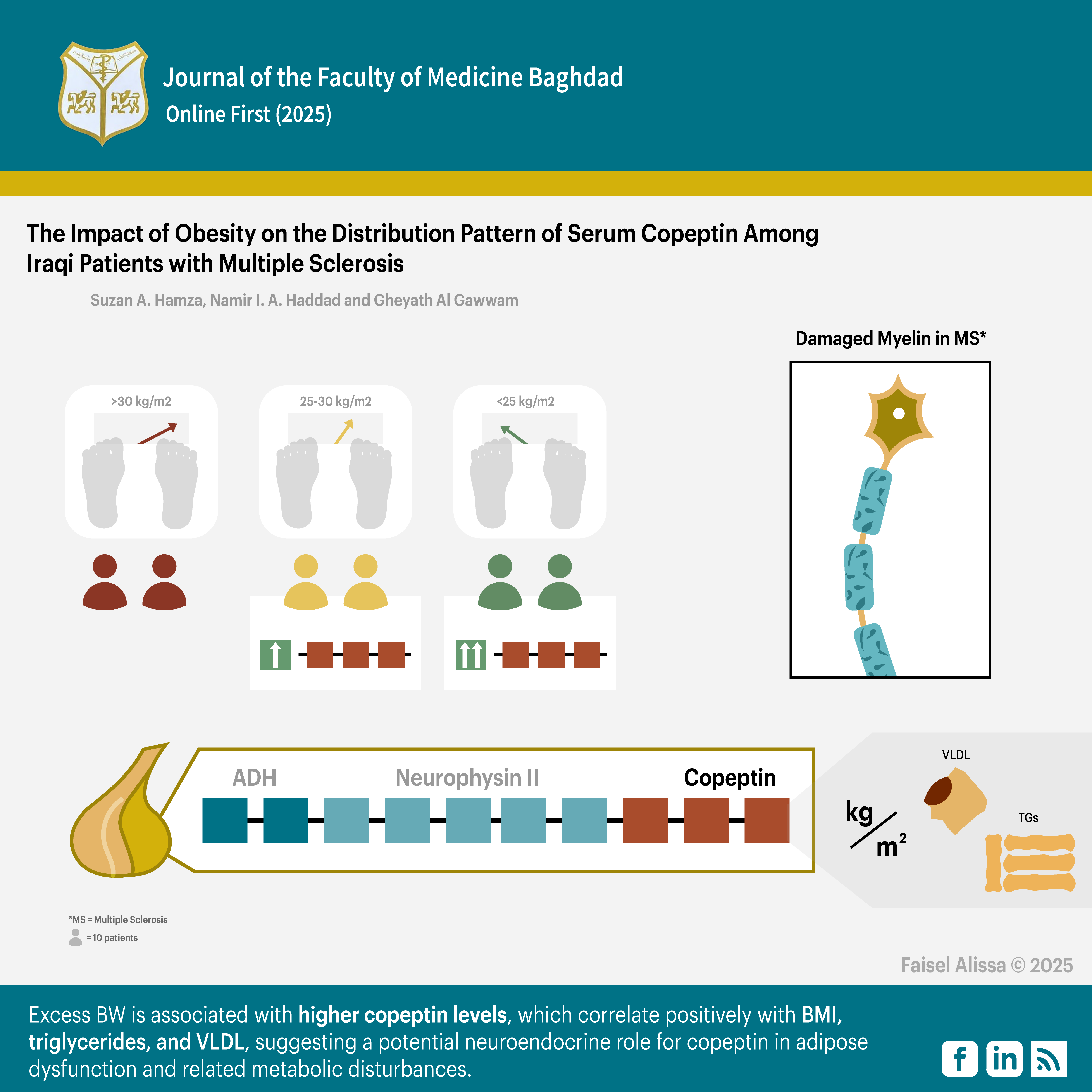
Background: Multiple sclerosis is an autoimmune illness that can be triggered by both hereditary and environmental factors. There are crucial roles for the neuroendocrine system in initiating autoreactive immunity at this stage. Copeptin is a promising inflammatory marker that has the potential to be employed as a prognostic factor in several disorders, particularly those affecting the central nervous system.
Objectives: In this research, we attempted to evaluate the relation of serum copeptin concentrations with weight increment in Iraqi patients with multiple sclerosis (MS).
Methods: A cohort of sixty Iraqi patients with multiple sclerosis took part in this study and were classified equally into three groups: obese group, overweight group, and normal-weight group. The serum lipid profile was estimated using a Biosystem kit, while serum copeptin was estimated using ELISA kit.
Results: Serum copeptin levels were higher in obese as well as overweight MS patients compared to MS patients with normal weight (170.7±29, 160±27.8 vs. 149.3±25.9) pg/ml, respectively. Also, it showed a significant positive correlation with body mass index, serum triglycerides and serum very low-density lipoprotein in overweight MS patients.
Conclusion: Iraqi multiple sclerosis patients who have excess body weight have higher levels of serum copeptin when compared to those MS patients with normal weight. The positive significant correlation of serum copeptin with body mass index, serum triglycerides, and serum low-density lipoprotein among overweight MS patients may indicate a vital role of copeptin as a neuroendocrine in the adipose dysfunction and related diseases.
Received: July 2025
Revised: Nov. 2025
Accepted: Dec. 2025
Published Online: Dec. 2025
Published: Dec.2025
Downloads
References
1. Ezer B, Ozdemir M. Relationship of serum hepatitis B Virus DNA levels with Hepcidin, Pentraxin-3, Zonulin, and Copeptin in chronic hepatitis B patients. The Journal of Infection in Developing Countries. 2025 Apr 29;19(04):615-22. https://doi.org/10.3855/jidc.20918.
2. Shu X, Cai F, Li W, Shen H. Copeptin as a diagnostic and prognostic biomarker in pediatric diseases. Clinical Chemistry and Laboratory Medicine (CCLM). 2025 Feb 25;63(3):483-98. https://doi.org/10.1515/cclm-2024-0839.
3. Hammad R, Elshafei A, Khidr EG, El-Husseiny AA, Gomaa MH, Kotb HG, Eltrawy HH, Farhoud H. Copeptin: a neuroendocrine biomarker of COVID-19 severity. Biomarkers in Medicine. 2022 Jun 1;16(8):589-97.
https://doi.org/10.2217/bmm-2021-1100.
4. Moodley N. Copeptin analysis in endocrine disorders. Frontiers in Endocrinology. 2023 Oct 4;14:1230045. https://doi.org/10.3389/fendo.2023.1230045.
5. Li H, Chen K, Yang L, Wang Q, Zhang J, He J. The role of plasma cortisol in dementia, epilepsy, and multiple sclerosis: A Mendelian randomization study. Frontiers in endocrinology. 2023 Mar 15;14:1107780. https://doi.org/10.3389/fendo.2023.1107780.
6. Christ-Crain M, Refardt J, Winzeler B. Approach to the patient:“utility of the copeptin assay”. The Journal of Clinical Endocrinology & Metabolism. 2022 Jun 1;107(6):1727-38.’ https://doi.org/10.1210/clinem/dgac070.
7. Genç B, Şen S, Aslan K, İncesu L. Volumetric changes in hypothalamic subunits in patients with relapsing remitting multiple sclerosis. Neuroradiology. 2023 May;65(5):899-905.
https://doi.org/10.1007/s00234-023-03122-z.
8. Jalleh R, Torpy DJ. The emerging role of copeptin. The Clinical Biochemist Reviews. 2021 Feb;42(1):17.
https://doi.org/10.33176/AACB-20-00001.
9. Eren F, Demir A, Yilmaz SE, Ozturk S. Evaluation of the relationship between the morphometric structure of the pituitary gland and fatigue in patients with multiple sclerosis. Multiple Sclerosis and Related Disorders. 2023 Jan 1;69:104470. https://doi.org/10.1016/j.msard.2022.104470.
10. Brasanac J, Hetzer S, Asseyer S, Kuchling J, Bellmann-Strobl J, Ritter K, Gamradt S, Scheel M, Haynes JD, Brandt AU, Paul F. Central stress processing, T-cell responsivity to stress hormones and disease severity in multiple sclerosis. Brain Communications. 2022 Apr 1;4(2):fcac086. https://doi.org/10.1093/braincomms/fcac086.
11. Thompson AJ, Banwell BL, Barkhof F, Carroll WM, Coetzee T, Comi G, Correale J, Fazekas F, Filippi M, Freedman MS, Fujihara K. Diagnosis of multiple sclerosis: 2017 revisions of the McDonald criteria. The Lancet Neurology. 2018 Feb 1;17(2):162-73.
https://doi.org/10.1016/S1474-4422(17)30470-2.
12. Kurtzke JF. Rating neurologic impairment in multiple sclerosis: an expanded disability status scale (EDSS). Neurology. 1983 Nov;33(11):1444-. https://doi.org/10.1212/WNL.33.11.1444.
13. Marrodan M, Farez MF, Balbuena Aguirre ME, Correale J. Obesity and the risk of Multiple Sclerosis. The role of Leptin. Annals of Clinical and Translational Neurology. 2021 Feb;8(2):406-24. https://doi.org/10.1002/acn3.51291.
14. Ahmed HT, Hussein SZ. Estimation of Resistin and Adiponectin Levels in Iraqi Women with Hypothyroidism. Iraqi Journal of Science. 2025 Oct 30:4078-90. https://doi.org/10.24996/ijs.2025.66.10.6.
15. Haddad NI, Nori E, Hamza SA. Serum Visfatin and Chemerin Levels in Iraqi Diabetics and Obese Individuals. RESEARCH JOURNAL OF PHARMACEUTICAL BIOLOGICAL AND CHEMICAL SCIENCES. 2017 Nov 1;8(6):356-64.
16. Ghaeb Al-Bayati IA, Ahmed SS, Sultan HI. Study the Relation of Copeptin and Some Biochemical Parameters in with Obesity in Kirkuk City. Indian Journal of Forensic Medicine & Toxicology. 2021 Apr 1;15(2).
http://doi.org/10.37506/ijfmt. v15i2.14533.
17. Alkabban MM, Alkhazrajy LA. Association between Body Mass Index and Depressive Symptoms among Adolescent Females in Baghdad, AlKarkh during 2022. Journal of the Faculty of Medicine Baghdad. 2023;65(4):348-53. https://doi.org/10.32007/jfacmedbagdad.2113.
18. Ad'hiah AH, Atiyah NS, Fadhil HY. Qualitative and Quantitative Molecular Analysis of Epstein-Barr Virus in Iraqi Patients with Relapsing-Remitting Multiple Sclerosis. Iraqi Journal of Science. 2023 Jan 30:127-37. https://doi.org/10.24996/ijs.2023.64.1.13.
19. Baranowska-Bik A, Kochanowski J, Uchman D, Litwiniuk A, Kalisz M, Martynska L, Wolinska-Witort E, Baranowska B, Bik W. Association of copeptin and cortisol in newly diagnosed multiple sclerosis patients. Journal of neuroimmunology. 2015 May 15;282:21-4. https://doi.org/10.1016/j.jneuroim.2015.03.011.
20. Koseoglu M, Ozben S, Gozubatik-Celik G, Tutuncu M, Kucuksayan E, Hanikoğlu A, Atakli D, Ozben T. Plasma copeptin levels in patients with multiple sclerosis. Journal of Clinical Neuroscience. 2020 Aug 1;78:143-6. https://doi.org/10.1016/j.jocn.2020.04.095.
21. İlgezdi İ, Sener U, Ocek L, Kose S, Sariteke A, Tokucoglu F, Zorlu Y. Copeptin levels in clinically silent multiple sclerosis. Turkish Journal of Neurology. 2022;28(4).. https://doi.org/10.4274/tnd.2022.95776.
22. Al-Fatlawi AC, Kamel AN, Hwan BG, Alwan AK, Jasim MH. Evaluation of Copeptin as a Novel Marker for Predicting the Prognosis of Fatty Liver Disease and its Complications in Obesity. Al-Ameed Journal for Medical Research and Health Sciences. 2023;1(2):5.
https://doi.org/10.61631/3005-3188.1009.
23. Atere AD, Ajani OF, Alade OG, Ajani LA, Moronkeji AI. Evaluation of diagnostic performance of serum copeptin in correlation with dyslipidemia in Obesed and Non-Obesed type 2 diabetes mellitus (T2DM). Al Ameen J Med Sci. 2020;13(4):226-33.
24. Rothermel J, Kulle A, Holterhus PM, Toschke C, Lass N, Reinehr T. Copeptin in obese children and adolescents: relationships to body mass index, cortisol and gender. Clinical endocrinology. 2016 Dec;85(6):868-73. https://doi.org/10.1111/cen.13235.
25. El-Raufe El-Masry SA, Mahmoud RA, Hassan NE, Aly MM, Abdallah HR, Hamdy S, Megahed S, Elalfy DY. Zonulin and copeptin relation to some metabolic markers in school-aged obese children. BMC pediatrics. 2024 Feb 24;24(1):140. https://doi.org/10.1186/s12887-024-04617-1
Downloads
Published
Issue
Section
Categories
License
Copyright (c) 2025 Suzan A. Hamza, Namir I. Haddad, Gheyath H. AL Gawwam

This work is licensed under a Creative Commons Attribution 4.0 International License.













 Creative Commons Attribution 4.0 International license..