Prevalence of Obsessive-Compulsive Disorder Symptoms in a Sample of Medical Students in Iraq
DOI:
https://doi.org/10.32007/jfacmedbaghdad2165Keywords:
Medical Students, Obsessive compulsive symptoms, Revised Arabic Scale of Obsession-CompulsionAbstract
Background: Obsessive-compulsive disorders (OCD) is a common mental health condition where a person has obsessive thoughts and compulsive behaviors. The worldwide prevalence of OCD is approximately 2% of the general population.
Objective: To assess prevalence of obsessive-compulsive disorder symptoms in a sample of medical students in Iraq.
Methods: A cross-sectional study design with a convenience sampling method, was conducted on 414 Iraqi medical students during
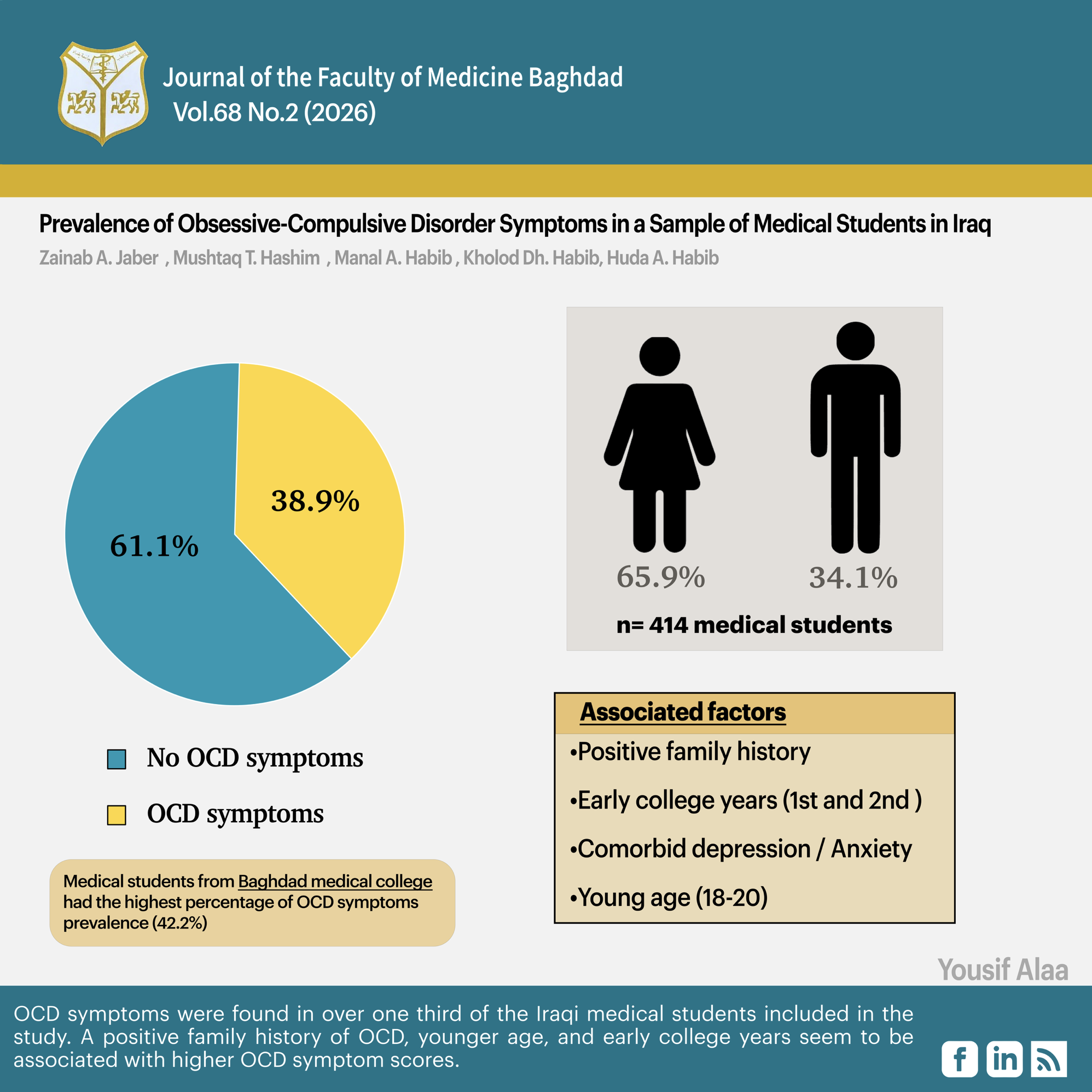
the period from 1st November, 2022 to 28th February, 2023. Data were collected using a structured questionnaire submitted online. The questionnaire consisted of two parts: The first included socio-demographic characteristics (age, gender, college year, residence, marital status) and risk factors, whereas the second part consisted of 20 items from the Revised Arabic Scale of Obsession-Compulsion.
Results: It was found that (38.9%) of participants had OCD symptoms. The overall weighted mean and standard deviation, was 2.13 ± 0.599, so any mean equal to or exceeding this value was highly indicative of OCDthe cut-off point). Significant associations were found between positive family history of OCD, age, college year, and OCD symptom score.
Conclusion: OCD symptoms were found in over one third of the Iraqi medical students included in the study. A positive family history of OCD, younger age, and early college years seem to be associated with higher OCD symptom scores.
Received: 18 June 2023,
Revised: 15 April 2026,
Accepted: 1st May 2026,
Published Online: May 2026,
Published: 01 July 2026
Published: 01 July 2026
Downloads
References
1. Carmi L, Brakoulias V, Arush OB, et al. A prospective clinical cohort-based study of the prevalence of OCD, obsessive compulsive and related disorders, and tics in families of patients with OCD. BMC Psychiatry. 2022 Mar 17;22(1):190. https://doi.org/10.1186/s12888-022-03807-4. DOI: https://doi.org/10.1186/s12888-022-03807-4
2. Fawcett EJ, Power H, Fawcett JM. Women Are at Greater Risk of OCD Than Men: A Meta-Analytic Review of OCD Prevalence Worldwide. J Clin Psychiatry. 2020 Jun 23;81(4):19r13085. https://doi.org/10.4088/JCP.19r13085. DOI: https://doi.org/10.4088/JCP.19r13085
3. Pampaloni I, Marriott S, Pessina E, et al. The global assessment of OCD. Compr Psychiatry. 2022 Oct;118:152342. https://doi.org/10.1016/j.comppsych.2022.152342. DOI: https://doi.org/10.1016/j.comppsych.2022.152342
4. Bandelow B, Allgulander C, Baldwin DS, et al. World Federation of Societies of Biological Psychiatry (WFSBP) guidelines for treatment of anxiety, obsessive-compulsive and posttraumatic stress disorders–Version 3. Part I: Anxiety disorders. The World Journal of Biological Psychiatry. 2023 Feb 7;24(2):79-117. https://doi.org/10.1080/15622975.2022.2086295. DOI: https://doi.org/10.1080/15622975.2022.2086295
5. American Psychiatric Association. Diagnostic and statistical manual of mental disorders. 5th ed. Arlington, VA: American Psychiatric Press; 2013. 235-264 https://doi.org/10.4103/0019-5545.117131. DOI: https://doi.org/10.1176/appi.books.9780890425596
6. Geddes JR, Andreasen NC, Goodwin GM, editors. New Oxford textbook of psychiatry. Oxford University Press 3rded; 2020. 765–774. https://doi.org/10.1093/med/9780198713005.001.0001. DOI: https://doi.org/10.1093/med/9780198713005.001.0001
7. Taher TMJ, Al-fadhul SAL, Abutiheen AA, et al. Prevalence of obsessive-compulsive disorder (OCD) among Iraqi undergraduate medical students in time of COVID-19 pandemic. Middle East Current Psychiatry.2021; 28(1), 1-8. https://doi.org/10.1186/s43045-021-00086-9. DOI: https://doi.org/10.1186/s43045-021-00086-9
8. Abas N, Qasim S. Prevalence of Obsessive-Compulsive Disorder Among Psychology Students. Journal of Garmian University, 2023; 10(1): 274-283. https://doi.org/10.24271/jgu.2023.101023. DOI: https://doi.org/10.24271/jgu.2023.101023
9. Hama R, Ahmed N. Obsessive compulsive symptoms among students of Faculty of Medical Sciences and Faculty of Humanities Education in University of Sulaimani. Journal of Sulaimani Medical College. 2018; 8(4), 299-305. https://doi.org/10.17656/jsmc.10182. DOI: https://doi.org/10.17656/jsmc.10182
10. Alhasnawi S, Sadik S, Rasheed M, et al. Iraq Mental Health Survey Study Group. The prevalence and correlates of DSM-IV disorders in the Iraq Mental Health Survey (IMHS). World Psychiatry. 2009 Jun;8(2):97-109. https://pmc.ncbi.nlm.nih.gov/articles/PMC2694515/.
11. Abdel-Khalek A. The Construction and Validation of the Revised Arabic Scale of Obsession Compulsion (ASOC). Online Journal of Neurology and Brain Disorders. 2018;1(2): 1-7. https://doi.org/10.32474/OJNBD.2018.01.000109. DOI: https://doi.org/10.32474/OJNBD.2018.01.000109
12. Alblowy AA. M. Assessment of Obsessive-Compulsive Disorder among Nursing Students in Al Riyada College in Jeddah and its Relationship to Some Variables. International Journal of Nursing Education. 2022;14(2), 34-44. https://doi.org/10.37506/ijone.v14i2.17985. DOI: https://doi.org/10.37506/ijone.v14i2.17985
13. Almutairi AM, Aladhadh KM, Alsayed SA, et al. Prevalence of obsessive-compulsive disorder symptoms among medical students. International Journal of Medicine in Developing Countries. 2021;5(5), 1183-1183. https://doi.org/10.24911/IJMDC.51-1616952490. DOI: https://doi.org/10.24911/IJMDC.51-1616952490
14. Khalaf AM, Alshuaibi SK, Bin FB, et al. The prevalence of obsessive-compulsive disorder and symptoms among medical students: A perspective study from Riyadh, Saudi Arabia. Med Sci. 2021; 25(114), 2088-95. https://discoveryjournals.org/medicalscience/current_issue/v25/n114/A37.pdf.
15. SoleimanvandiAzar N, Amirkafi A, Shalbafan M, et al. Prevalence of obsessive-compulsive disorders (OCD) symptoms among health care workers in COVID-19 pandemic: a systematic review and meta-analysis. BMC psychiatry. 2023; 23(1), 862. https://doi.org/10.1186/s12888-023-05353-z. DOI: https://doi.org/10.1186/s12888-023-05353-z
16. Fontenelle LF, Muhlbauer JE, Albertella L, et al. Traumatic and stressful life events in hoarding: the role of loss and deprivation. Eur J Psychotraumatol. 2021 Jul 22;12(1):1947002. https://doi.org/10.1080/20008198.2021.1947002. DOI: https://doi.org/10.1080/20008198.2021.1947002
17. Goessmann K, Ibrahim H, Neuner F. Association of war-related and gender-based violence with mental health states of Yazidi women. JAMA network open. 2020; 3(9): e2013418. https://doi.org/10.1001/jamanetworkopen.2020.13418. DOI: https://doi.org/10.1001/jamanetworkopen.2020.13418
18. Salami B, Iwuagwu S, Amodu O, et al. The health of internally displaced children in sub-Saharan Africa: a scoping review. BMJ Global Health. 2020; 5(8), e002584. https://doi.org/10.1136/bmjgh-2020-002584. DOI: https://doi.org/10.1136/bmjgh-2020-002584
19. Linde ES, Varga TV, Clotworthy A. Obsessive-compulsive disorder during the COVID-19 pandemic—a systematic review. Frontiers in psychiatry. 2022;13, 806872. https://doi.org/10.3389/fpsyt.2022.806872. DOI: https://doi.org/10.3389/fpsyt.2022.806872
20. Grant JE, Drummond L, Nicholson TR, et al. Obsessive-compulsive symptoms and the Covid-19 pandemic: A rapid scoping review. Neuroscience & Biobehavioral Reviews. 2022; 132, 1086-1098. https://doi.org/10.1016/j.neubiorev.2021.10.039. DOI: https://doi.org/10.1016/j.neubiorev.2021.10.039
21. Davoudi M, Sadoughi M, Pourshahbaz A, et al. Exploring the structure of the university-students obsessive–compulsive tendency scale in Iranian university students: a network analysis study. BMC Research Notes. 2023; 16(1), 193. https://doi.org/10.1186/s13104-023-06474-0. DOI: https://doi.org/10.1186/s13104-023-06474-0
22. Moh’d A S. Obsessive-compulsive symptom prevalence among university students and associated demographic variables. Arab Journal of Psychiatry. 2021;32(1):79-85. https://doi.org/10.12816/0058768. DOI: https://doi.org/10.12816/0058768
23. Sultan S, Fallata EO, Bashar MA, et al. Prevalence, socio demographic and academic correlates of obsessive-compulsive disorder in the students of college of applied medical sciences, Umm Al-Qura university. Journal of Obsessive-Compulsive and Related Disorders. 2021;28:100604. https://doi.org/10.1016/j.jocrd.2020.100604. DOI: https://doi.org/10.1016/j.jocrd.2020.100604
24. Jaisoorya TS, Janardhan Reddy YC, Nair BS, et al. Prevalence and correlates of obsessive-compulsive disorder and sub threshold obsessive-compulsive disorder among college students in Kerala, India. Indian J Psychiatry. 2017 Jan-Mar;59(1):56-62. https://doi.org/10.4103/0019-5545.204438. DOI: https://doi.org/10.4103/0019-5545.204438
25. Torres AR, Cruz BL, Vicentini HC, et al. Obsessive-Compulsive Symptoms in Medical Students: Prevalence, Severity, and Correlates. Acad Psychiatry. 2016 Feb;40(1):46-54. https://doi.org/10.1007/s40596-015-0357-2. DOI: https://doi.org/10.1007/s40596-015-0357-2
26. Pacheco JP, Giacomin HT, Tam WW, et al. Mental health problems among medical students in Brazil: a systematic review and meta-analysis. Braz J Psychiatry. 2017 Oct-Dec;39(4):369-378. https://doi.org/10.1590/1516-4446-2017-2223. DOI: https://doi.org/10.1590/1516-4446-2017-2223
27. Backović DV, Maksimović M, Davidović D, et al. Stress and mental health among medical students. Srp Arh Celok Lek. 2013 Nov-Dec;141(11-12):780-4. Serbian. https://doi.org/10.2298/sarh1312780b. DOI: https://doi.org/10.2298/SARH1312780B
28. Hankir AK, Northall A, Zaman R. Stigma and mental health challenges in medical students. BMJ Case Rep. 2014 Sep 2;2014:bcr2014205226. https://doi.org/10.1136/bcr-2014-205226. DOI: https://doi.org/10.1136/bcr-2014-205226
29. Sheldon E, Simmonds-Buckley M, Bone C, et al. Prevalence and risk factors for mental health problems in university undergraduate students: A systematic review with meta-analysis. J Affect Disord. 2021 May 15;287:282-292. https://doi.org/10.1016/j.jad.2021.03.054. DOI: https://doi.org/10.1016/j.jad.2021.03.054
30. Jaber ZA, Salman RT, Abid Al Wahab DY, et al. Assessment of the Depression Level among Medical Students at University of Baghdad, College of Medicine. Al-Kindy Col. Med. J [Internet]. 2021 Dec. 30 ;17(3):175-9. https://doi.org/10.47723/kcmj.v17i3.248. DOI: https://doi.org/10.47723/kcmj.v17i3.248
31. Al-Hemiary NJ, Al-Hasnawi SM. Seeking Help from Faith Healers among Iraqi Patients with Obsessive – Compulsive Disorder. J Fac Med Bagdad. 2010 Jan. 3;51(4):385-7. https://doi.org/10.32007/jfacmedbagdad.5141089. DOI: https://doi.org/10.32007/jfacmedbagdad.5141089
Downloads
Published
Issue
Section
Categories
License
Copyright (c) 2026 Zainab A. Jaber, Mushtaq T. Hashim, Manal A. Habib, Kholod Dh. Habib, Huda A. Habib

This work is licensed under a Creative Commons Attribution 4.0 International License.












 Creative Commons Attribution 4.0 International license..