Comparison between Meatal Advancement and Glanuloplasty with Urethral Advancement and Glanuloplasty in Treatment of Distal Hypospadias
DOI:
https://doi.org/10.32007/jfacmedbaghdad3205Keywords:
Congenital malformation, Complications, Hypospadias, Glanuloplasty, Urethral advancementAbstract
Background: Hypospadias is the second most common congenital malformation and may be classified according to the anatomical site of urethral meatus into distal, which accounts for about 70-80% of all hypospadias cases, and proximal, which is rare. There are multiple surgical options for the management of hypospadias. This study covers cases of distal hypospadias with two surgical options, which are urethral advancement and Glanuloplasty, and meatal advancement glanuloplasty.
Objectives: To compare the surgical outcomes and complications of urethral advancement and meatal advancement with glanuloplasty for the treatment of distal hypospadias.
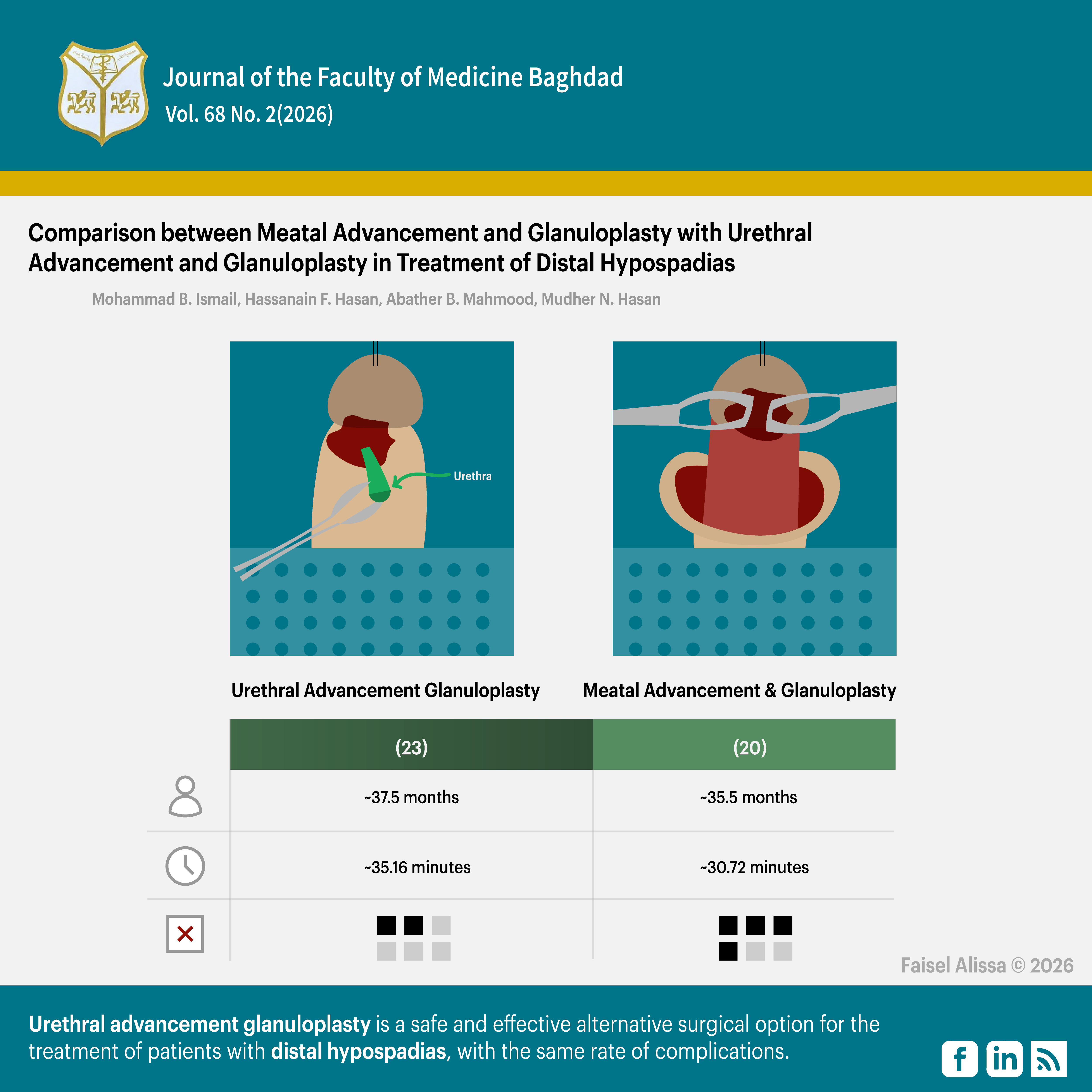
Methods: Forty-three patients, 20 of whom underwent meatal advancement and glanuloplasty and 23 underwent urethral advancement glanuloplasty, were followed up for 6 months after the operation at Ghazi Al-Hariri Hospital, Medical City Complex, Baghdad, Iraq, for the surgical speciality during the period from April 2017 to March 2020.
Results: The mean age of the meatal advancement and glanuloplasty group at surgery was (35.5+17.31 months) which was comparable to that of the urethral advancement glanuloplasty group (37.5+14.27 months) with no significant difference. There were no significant differences between the groups in operative time, which was 35.16+2.9 min in urethral advancement glanuloplasty and 30.72+3.2 min in meatal advancement and glanuloplasty. Six complications were reported in this study, four of which (two meatal stenosis
and 2 wound dehiscence) occurred in the meatal advancement and glanuloplasty group, while two complications (one meatal stenosis and one meatal retraction) occurred in the urethral advancement glanuloplasty group.
Conclusions: Urethral advancement glanuloplasty is a safe and effective alternative surgical option for the treatment of patients with distal hypospadias, especially those with a non-mobile meatus, with the same rate of complications.
Downloads
References
1. Alwaeli HH, Al-Timimi HF, Ismail MB. Assessment of functional and cosmetic outcomes of Extended-Tubularized incised plate for mid-shaft and distal hypospadias as a modification of Snodgrass repair: a cross-sectional study. Ann. Med. Surg. 2023 Oct 1;85(10):4745-9. https://doi.org/10.1097/MS9.0000000000001136.
2. Arendt LH, Ernst A, Lindhard MS, et al. Accuracy of the hypospadias diagnoses and surgical treatment registrations in the Danish National Patient Register. Clin Epidemiol. 2017; 9:483-489. https://doi.org/10.2147/CLEP.S143118.
3. Żukowska A, Król M, Kupnicka P, et al. Exploring Recent Developments in the Manifestation, Diagnosis, and Treatment of Patients with Smith-Lemli-Opitz Syndrome: From Molecular Pathways to Clinical Innovations. International Journal of Molecular Sciences. 2025 Jul 11;26(14):6672. https://doi.org/10.3390/ijms26146672.
4. Patil A, Sharma A, Mane N, et. al. Hypospadias Repair Using Transverse Preputial Island Flap. J Ped Nephrol. 2018;6(3):1-9. https://doi.org/10.22037/jpn.v6i3.23371.
5. Donaire AE, Mendez MD. Hypospadias. In: StatPearls. Treasure Island (FL): StatPearls Publishing; 2020 Jan-. Available from: https://www.ncbi.nlm.nih.gov/books/NBK482122.
6. Manzoni G, Bracka A, Palminteri E, et al. Hypospadias surgery: when, what and by whom? BJU international. 2004 Nov;94(8):1188-95. https://doi.org/10.1046/j.1464-410x.2004.05128.x
7. Keays MA, Dave S. Current hypospadias management: Diagnosis, surgical management, and long-term patient-centred outcomes. Can Urol Assoc J. 2017;11(1-2Suppl1): S48-S53. https://doi.org/10.5489/cuaj.4386.
8. Hayashi Y., Yamataka A. Hypospadias. In: Taguchi T, Iwanaka T, Okamatsu T, editors. Operative General Surgery in Neonates and Infants. Springer: Tokyo; 2016. 333 -339. https://doi.org/10.1007/978-4-431-55876-7.
9. Allawi BS. Evaluation of Urethral advancement and Glanuloplasty in Hypospadias repair. QADMJ. 2026;12(22):139-54. https://doi.org/10.28922/qmj.2016.12.22.139-154.
10. Ekinci S, Ciftci AO, Karnak I, et al. Eccentric circummeatal based flap with limited urethral mobilization: an easy technique for distal hypospadias repair. J Pediatr Urol. 2016;12(2):116.e1-116.e6.. https://doi.org/10.1016/j.jpurol.2015.09.013.
11. Atala A. Urethral mobilization and advancement for mid shaft to distal hypospadias. J Urol. 2002; 168:1738–1741.
https://doi.org/10.1016/S0022-5347(05)64402-3.
12. Awad MM, Tolba AM, Saad KM, et al. What is the best choice for repair of distal penile hypospadias: the tubularized incised plate urethroplasty or anterior urethral advancement technique?. Indian J Plast Sur. 2007; 40(02):182–188.
https://doi.org/10.4103/0970-0358.37765.
13. Elemen L, Tugay M. Limited urethral mobilization technique in distal hypospadias repair with satisfactory results. Balkan Med J. 2012; 2012(1):21–25. https://doi.org/10.5152/balkanmedj.2011.008.
14. Hashish MS, Elsawaf MI, Moussa MA. Urethral advancement procedure in the treatment of primary distal hypospadias: a series of 20 cases. Ann Pediatr Surg. 2017; 13(1):29–37. https://doi.org/10.1097/01.XPS.0000503268.11426.ab.
15. Jawad AJ. Urethral Advancement and glanuloplasty UAGP vs. MAGPI for distal hypospadias repair. Int Urol Nephrol. 1997;29(6):681-686. https://doi.org/10.1007/BF02552186.
16. Paparel P, Mure PY, Garignon C, et al. Urethral mobilization: report of 26 hypospadias presenting a distal division of the corpus spongiosum. Socie´te´ franc¸aise d’urologie. 2001; 11:1327–1330. https://europepmc.org/article/med/11859675.
17. Hassan HS, Almetaher HA, Mohammed N, et al. Urethral mobilization and advancement for distal hypospadias. Ann Pediatr Sur. 2015; 11:239–243. https://doi.org/10.1097/01.XPS.0000472853.75905.28.
18. Duckett JW. MAGPI (meatoplasty and glanuloplasty) a procedure for subcoro nal hypospadias. J. Urology. 2002 May;167(5):2153-6. https://doi.org/10.1016/S0022-5347(05)65116-6
19. Kumar U, Singh V, Bhat A. Management of Distal and Mid-Penile Hypospadias. In: Hypospadiology: Principles and Practices. Singapore: Springer,2022. 79-100. https://doi.org/10.1007/978-981-16-8395-4_7.
20. Kassaby AE, Abdelhay S. Long-Term Outcomes of the Glanular Rotation Procedure (GRP) for Glanular and Coronal Hypospadias. Ain-Shams J Surg. 2025 Oct 1;18(4):271-7. https://doi.org/10.21608/asjs.2025.393720.1212.
21. Vallasciani S. Meatal Advancement and Glanduloplasty Incorporated (MAGPI). In: Video Atlas of Hypospadias Surgery. Singapore: Springer Nature; 2024. 23-27. .https://doi.org/10.1007/978-981-99-0795-3_3.
Downloads
Published
Issue
Section
Categories
License
Copyright (c) 2026 Mohammad B. Ismail, Abather B. Mahmood, Hassanain F. Hasan, Mudher N. Hasan

This work is licensed under a Creative Commons Attribution 4.0 International License.














 Creative Commons Attribution 4.0 International license..