Prevalence of Depression and Related Factors among International Medical Students at Tehran University of Medical Sciences
DOI:
https://doi.org/10.32007/jfacmedbaghdad3043Keywords:
Associated factors, Depression, International medical students, Prevalence, Sociodemographic variablesAbstract
Background: In accordance with DSM-5-TR, Depression is a common psychiatric disorder marked by persistent sadness, loss of interest, and impairment in everyday activities. Recent evidence shows that between 22% and 45% of international student’s experience depressive symptoms. There is limited information on the prevalence of depression among international medical students at the International Campus of Tehran University of Medical Sciences.
Objectives: To investigate the prevalence of depression among international medical students at the International Campus of Tehran University of Medical Sciences and to examine related factors.
Methods: A cross-sectional study was conducted at the International Campus of Tehran University of Medical Sciences in 2022, after obtaining approval for the proposal and permission from relevant authorities. A valid questionnaire was distributed to international medical students in the International Campus of Tehran University of Medical Sciences online. A total of 215 students completed the questionnaire, and their responses were entered into SPSS version 26 for descriptive and inferential analysis. Statistical methods used included Pearson correlation coefficient analysis, student t test, and regression models.
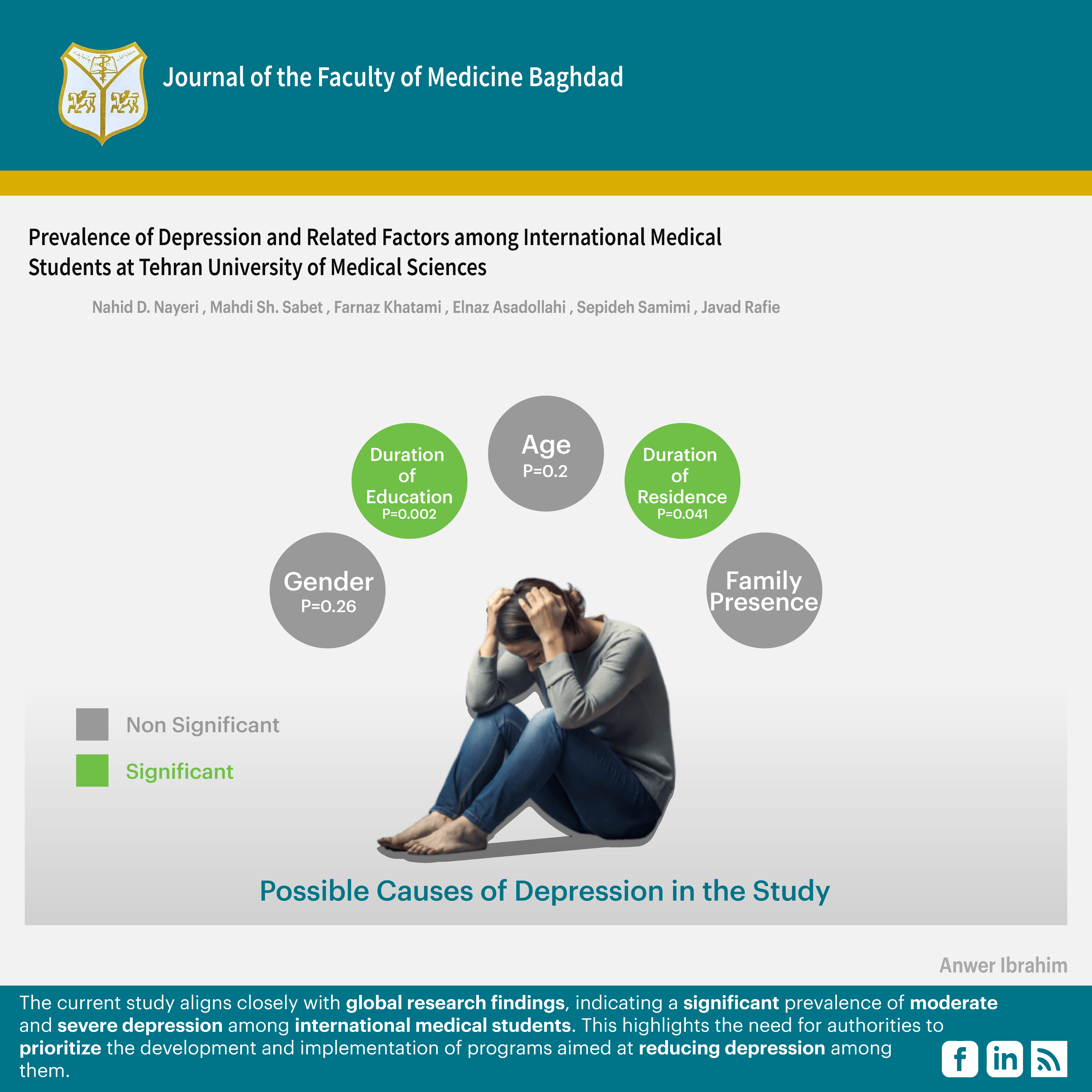
Results: The age range of participants was 17 to 32 years, with a mean of 22.3±2.74, with 54% females and 46% males. One-third of the students were Indian (34.3%), and the remaining were Pakistanis (27.5%). Those first-born in their families were (42.8%), and most of the students' parents were still alive. Nearly half of the participants were in their first or second year of education, and (9.8%) expressed little or no interest in the field of medicine, while about 40% expressed a great deal of interest. Over one-fifth of the participants experienced mild depression, and 16.7% recorded severe depression. The regression analysis revealed that none of the examined demographic and academic variables significantly affected depression scores. Even though the period of residence in Iran and study were associated with depression scores, they did not appear as critical predictors in the regression model.
Conclusion: The current study aligns closely with global research findings, indicating a significant prevalence of moderate and severe depression among international medical students. This highlights the need for authorities to prioritize the development and implementation of programs aimed at reducing depression among them
Received: Dec 2024
Revised: Dec. 2025
Accepted: Mar. 2026
Published Online: April 2026
Published: 01 July 2026
Downloads
References
1. Maj M, Stein DJ, Parker G, Zimmerman M, Fava GA, De Hert M, et al. The clinical characterization of the adult patient with depression aimed at personalization of management. World Psychiatry. 2020;19(3):269-93. https://doi.org/10.1002/wps.20771
2. Alan EK, editor Encyclopedia of psychology. Am Psychol Assoc; 2000.
3. Buch AM, Liston C. Dissecting diagnostic heterogeneity in depression by integrating neuroimaging and genetics. Neuropsychopharmacology. 2021;46(1):156-75.
https://doi.org/10.1038/s41386-020-00789-3
4. Reddy M. Depression: the disorder and the burden. SAGE Publications Sage India: New Delhi, India; 2010. p. 1-2.
5. Friedrich MJ. Depression is the leading cause of disability around the world. Jama. 2017;317(15):1517-. https://doi.org/10.1001/jama.2017.3826
6. Aguilar-Latorre A, Serrano-Ripoll MJ, Oliván-Blázquez B, Gervilla E, Navarro C. Associations between severity of depression, lifestyle patterns, and personal factors related to health behavior: secondary data analysis from a randomized controlled trial. Frontiers in psychology. 2022;13:856139. https://doi.org/10.3389/fpsyg.2022.856139
7. Hadjistavropoulos HD, Pugh NE, Hesser H, Andersson G. Therapeutic alliance in internet‐delivered cognitive behaviour therapy for depression or generalized anxiety. Clinical psychology & psychotherapy. 2017;24(2):451-61. https://doi.org/10.1002/cpp.2014
8. Mohtashamipour E, Mohtashamipour M, Shadlomashhadi F, Emadzadeh A, Hasanabadi H. The Survey of Pray and Depression Rate Relationship in Paramedical and Health Students of Mashad University. 2003.
9. Erturk S, Luu LAN. Adaptation of Turkish international students in Hungary and the United States: A comparative case study. International Journal of Intercultural Relations. 2022;86:1-13.
https://doi.org/10.1016/j.ijintrel.2021.10.006
10. Eryilmaz A, Deniz ME, Gülgün U, KURTULUŞ HY. Examination of university students' experiences regarding the university adaptation process. Yıldız Journal of Educational Research. 2023;8(1):11-27. https://doi.org/10.14744/yjer.2023.017
11. Zhong R, Chen Y, Wang D, Xiao F. Study on cross-cultural adaptability of students of articulation program-Taking Chinese students studying abroad at Harding University in the US as an example. Open Journal of Social Sciences. 2020;8(12):56. https://doi.org/10.4236/jss.2020.812006
12. Gao Y, Hu D, Peng E, Abbey C, Ma Y, Wu C-I, et al. Depressive symptoms and the link with academic performance among rural Taiwanese children. International journal of environmental research and public health. 2020;17(8):2778. https://doi.org/10.3390/ijerph17082778
13. Sowińska A, Pezoa Tudela R. Living with invisible medical disabilities: experiences and challenges of Chilean university students disclosed in medical consultations. International Journal of Qualitative Studies on Health and Well-being. 2023;18(1):2221905.
https://doi.org/10.1080/17482631.2023.2221905
14. Shinagawa N, Inada T, Gomi H, Akatsu H, Yoshida M, Kawakami Y. Challenges and experiences to develop a Japanese language course for international medical students in Japan: Maximising acquisition of Japanese language by applying adult learning theories. The Asia Pacific Scholar. 2022;7(1):3. https://doi.org/10.29060/TAPS.2022-7-1/GP2655
15. Steiner-Hofbauer V, Holzinger A. How to cope with the challenges of medical education? Stress, depression, and coping in undergraduate medical students. Academic psychiatry. 2020;44:380-7.
https://doi.org/10.1007/s40596-020-01193-1
16. Claramita M, Prabandari YS, Graber A, Scherpbier AJ. Challenges of communication skills transfer of medical students in the cultural context of Indonesia. Interdisciplinary Journal of Problem-Based Learning. 2020;14(1):n1. https://doi.org/10.14434/ijpbl.v14i1.28594
17. Mato CN, Uzosike TC, Ijah RFOA, Alali AA. Challenges and Opportunities of a Shared Medical Facility for the Training of Medical Students in Rivers State: Perspective of Stakeholders and the Medical Students. British Journal of Healthcare and Medical Research-Vol. 2023;10(1). https://doi.org/10.14738/bjhmr.101.13815
18. Mostafa P, Nayera S. Challenges and Expectations of First Year International Medical Students in Egypt. Educational Research and Innovation Journal. 2024;4(12):1-12.
https://doi.org/10.21608/erji.2024.323645
19. Murzalieva A, Saloni M, Bhamini P. Climatic challenges for indian students in the case of the international medical faculty students'(Kyrgyzstan). Scientific Collection «InterConf». 2023(157):267-72. https://media.neliti.com/media/publications/626267-climatic-challenges-for-indian-students-329d18ae.pdf
20. Gold JA, Hu X, Huang G, Li W-Z, Wu Y-F, Gao S, et al. Medical student depression and its correlates across three international medical schools. World journal of psychiatry. 2019;9(4):65.
https://doi.org/10.5498/wjp.v9.i4.65
21. Kretz S. Cognitive Vulnerability and International Student Stress: A Test of the Diathesis-Stress Model of Depression in International Students in Spain: The Ohio State University; 2013.
https://doi.org/10.1037/e609472013-001
22. Hope V, Henderson M. Medical student depression, anxiety and distress outside N orth A merica: a systematic review. Medical education. 2014;48(10):963-79.
https://doi.org/10.1111/medu.12512
23. Fukuya Y, Fujiwara T, Isumi A, Ochi M. Association of birth order with mental health problems, self-esteem, resilience, and happiness among children: results from a-child study. Frontiers in Psychiatry. 2021;12:638088. https://doi.org/10.3389/fpsyt.2021.638088
24. Youssef FF. Medical student stress, burnout and depression in Trinidad and Tobago. Academic Psychiatry. 2016;40:69-75. https://doi.org/10.1007/s40596-015-0468-9
25. Rotenstein LS, Ramos MA, Torre M, Segal JB, Peluso MJ, Guille C, et al. Prevalence of depression, depressive symptoms, and suicidal ideation among medical students: a systematic review and meta-analysis. Jama. 2016;316(21):2214-36. https://doi.org/10.1001/jama.2016.17324
26. Chaliawala KS, Vidourek RA, King KA. Exploring the impact of depression, stress, and sleep disturbances on academic success in international college students. Journal of International Students. 2025;15(7):85-108. https://doi.org/10.32674/x8d6rf31
27. Ingraham S, Mason L. Mental Health and Well-Being in International Education: Reflections on Providing Support for Students and Administrators. Global Education Research Reports. Institute of International Education. 2023.
Downloads
Published
Issue
Section
Categories
License
Copyright (c) 2026 Nahid D. Nayeri, Mahdi Sh. Sabet, Farnaz Khatami, Elnaz Asadollahi; Sepideh Samimi; Javad Rafie

This work is licensed under a Creative Commons Attribution 4.0 International License.











 Creative Commons Attribution 4.0 International license..