Free Paper Publication
21.01.2026

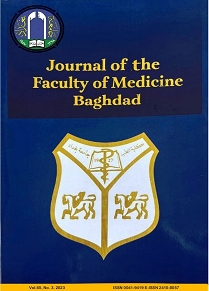
Journal of the Faculty of Medicine Baghdad (J Fac Med Baghdad) is a peer-reviewed journal published quarterly (April, July, October, and December) by the College of Medicine, University of Baghdad.
The Journal provides an Open Journal System powered by PKP as a communication platform for researchers, physicians, and medical workers in different aspects of medicine and basic medical sciences worldwide. It accepts original articles, review articles, case reports, letters to the editor, short communications, and editorials in all fields relevant to medicine.
Historically, this journal is the first medical journal in the Middle East. The journal was established in December 1935 under the name (The Journal of the Royal Faculty of Medicine of ‘Iraq) by the Royal Medical College (founded at the end of 1927). The first five volumes were published only in Arabic and approved by the council of the college as a general journal dealing with the news of the college and a few scientific articles to encourage the teaching staff for research publication. It disseminated official information on the progress of the health sector and strengthened the link between the medical family in Iraq and the health authorities.
In addition to the Arabic section that contained official information of the medical family, an English section was launched in 1941. The English section contained research dealing with all the medical facts and discoveries that were relevant to the country in order to combat communicable and endemic diseases in the Kingdom of Iraq. The publication continued until the end of 1957, when it had to be discontinued due to a shortage of material.
In 1959, Prof. Dr. Faisal Al-Sabih became the journal's editor-in-chief, restructured the journal, changed its name to The Journal of the Faculty of Medicine Baghdad, and used a new scientific system to publish articles.
A new series began in January 1959. According to this, time for research and facilities were being available for staff members. A section introducing the activities and achievements of various school departments was included. The journal supplied useful reading for the Iraqi medical profession and conveyed to colleagues abroad to better understand the activities that had hitherto rarely been available outside Iraq.
The journal has continued to be published regularly without interruption (four issues during the year). The journal became registered with the International Number (ISSN) in 2000 and entered many important international indexes.
After 2003, the journal continued despite the difficulties involved in every aspect of the country. By the beginning of 2004, the journal had progressed through a series of changes to reach a level recognized internationally.
In 2018, the journal became published online with the same edited issues.
The founders of the journal, whether Iraqis or other nationalities who contributed to managing this journal and publishing it, have chronicled the periods of development of medicine in Iraq, taking into consideration that the research that was published in it was receiving global echo as it was a rich source for foreigners, researchers, and many of their articles and dissertations on researchers published in this journal.
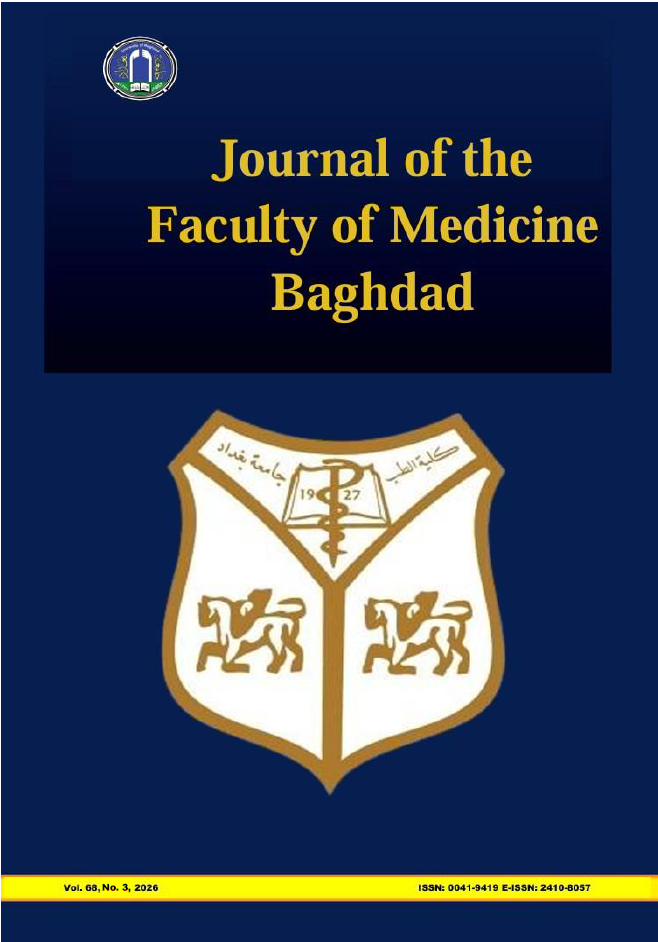

Publisher: College of Medicine,

Print ISSN: 0041-9419
Online ISSN: 2410-8057
Journal of the Faculty of Medicine Baghdad (JFacMed Baghdad) is peer-reviewed and open-access.
Editor-in-Chief:
Prof. Dr. Faris H. Al Lami
Managing Editor:
Prof. Dr. Rand R. Hafidh

Published Quarterly
New Series 1959: January, April, July & October
2000-2023: April, July, October, and January of next year
2024 onwards (on the 1st of April, July, October, & 31st of December)
From 2025 onwards, the "Online-First model for publication will be considered.

Each published paper in the Journal of the Faculty of Medicine Baghdad has a digital object identifier (DOI) number.
Time to first decision: 10 days' Time to acceptance: 150 days Acceptance rate: 28%




This work is licensed under  Creative Commons Attribution 4.0 International license..


Contact us
Website: http://www.iqjmc.uobaghdad.edu.iq 


Email: [email protected]
Mobile: 009647709826825.
Working Days: Sunday to Thursday (09:00 am-02:00 pm).
Address: Journal of the Faculty of Medicine Baghdad, College of Medicine, University of Baghdad, Baghdad. Bab Al Muadham, Baghdad, Iraq.
PO box 61023, code 12114.